
High-volume T-shirt production can create strong margins and stable supply, but one weak factory decision can lead to thin fabric, shrinkage, print failure, bad sizing, and costly returns.
The best wholesale custom T-shirt program combines stable fabric quality, accurate sizing, strong print durability, controlled shrinkage, reliable stitching, and repeatable bulk consistency across every production run.
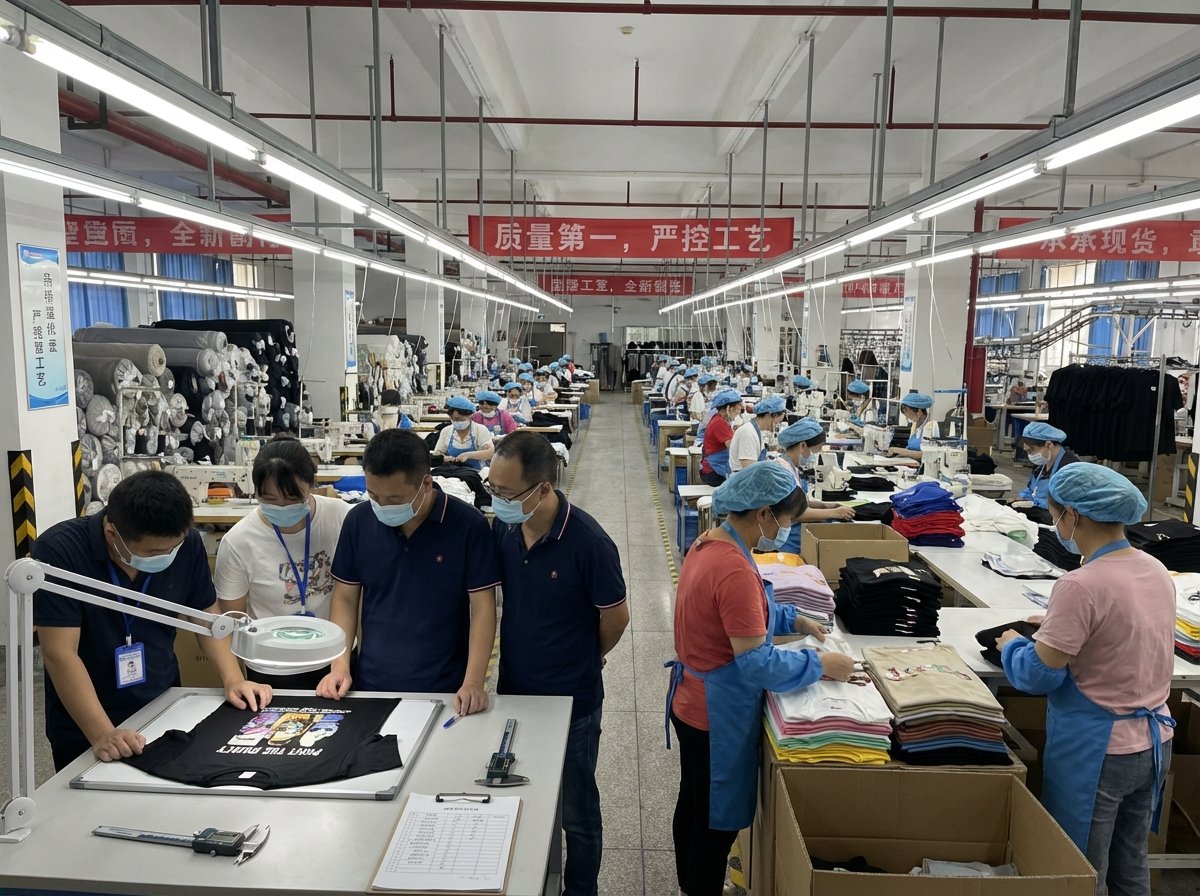
High-volume custom T-shirt production looks simple from the outside. A fabric is chosen. A design is printed. A size range is packed. Then the order ships. In real production, the process is much more sensitive than that. Market feedback from Reddit, Amazon, Trustpilot, YouTube, Instagram, Facebook, and review platforms shows the same complaints again and again. T-shirts are too thin. White shirts are see-through. Cotton shirts shrink in length after washing. Sleeves feel too short or fit strangely. Side seams twist. Necklines fray. Prints crack or peel after a few washes. Some shirts even develop holes after a short period of wear. These problems are not random. Most of them come from factory-side decisions in fabric, pattern, printing, sewing, finishing, and quality control.
That is why wholesale custom T-shirt production should never be judged by price alone. A low quote means very little if the shirt looks cheap, loses shape, fades fast, or becomes unwearable after washing. High-volume production needs systems that protect both product quality and repeat consistency. The more units involved, the more important those systems become.
Why Does High-Volume Custom T-Shirt Production Need More Control?
A large T-shirt order magnifies every small mistake.
In wholesale production, thin fabric, unstable sizing, poor print adhesion, weak seams, or loose quality control do not stay small. They become full-order problems.
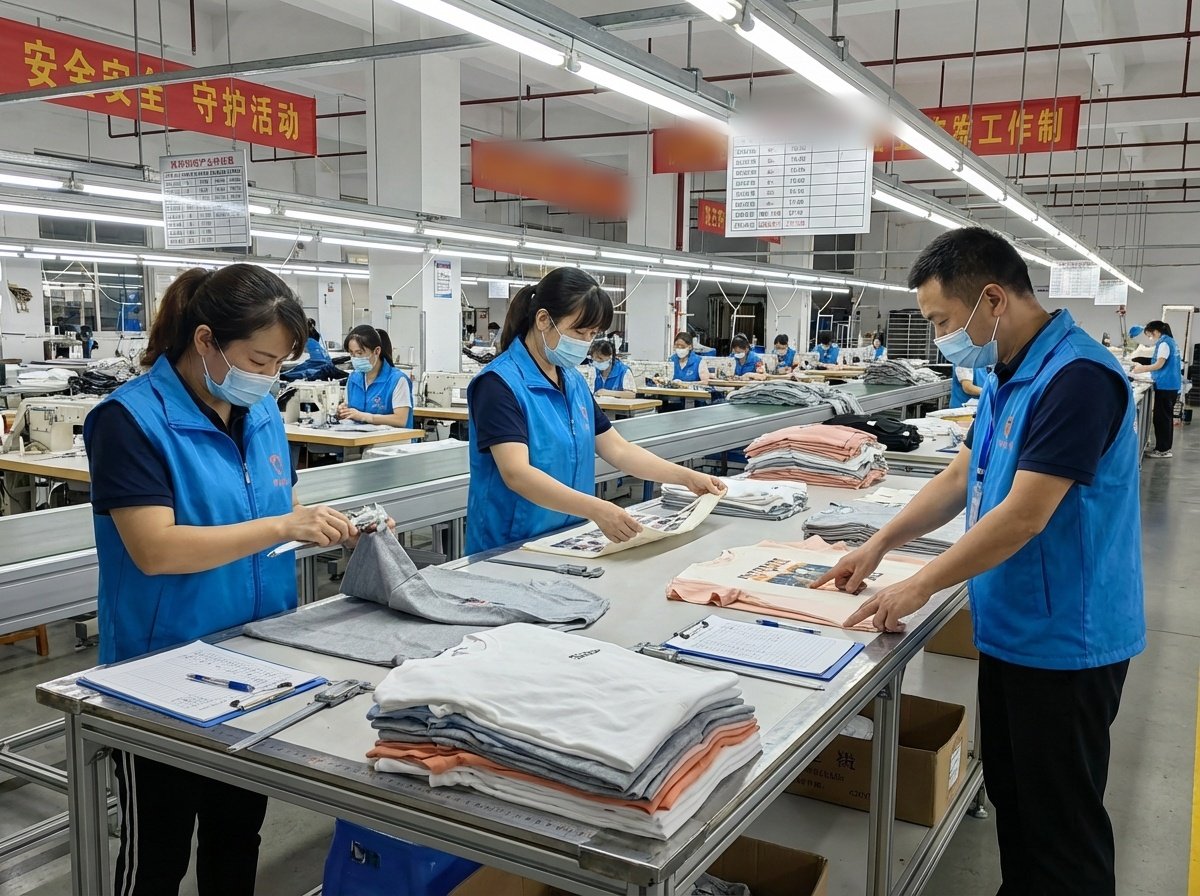
This matters because many T-shirt complaints are not about fashion taste. They are about product failure. The insight table shows repeated frustration around shirts that are paper-thin, transparent, too short after washing, twisted after one wash, or already breaking at the neckline and hem. When those failures happen in a small run, the damage is limited. When they happen in wholesale production, the cost rises fast through claims, replacements, discounting, and lost trust.
High-volume production also creates pressure on consistency. One sample may look good, but the real challenge is keeping the same fabric hand feel, color, print quality, fit, and stitching across the whole order. Strong manufacturers treat this as a control problem, not as a hope problem. They lock standards before bulk starts and keep checking them during production.
| In small orders | In high-volume orders |
|---|---|
| A defect affects a few units | A defect affects the whole program |
| Minor variation may be tolerated | Variation quickly becomes a return issue |
| Sampling matters | Sampling and bulk repetition both matter |
| Cost is important | Cost and consistency matter equally |
How to Choose the Right Wholesale Custom T-Shirt Manufacturer for High-Volume Orders
The right manufacturer is not simply the one with the lowest quote.
The right wholesale custom T-shirt factory is the one that can hold fabric quality, fit accuracy, print durability, shrinkage control, and bulk consistency at scale.
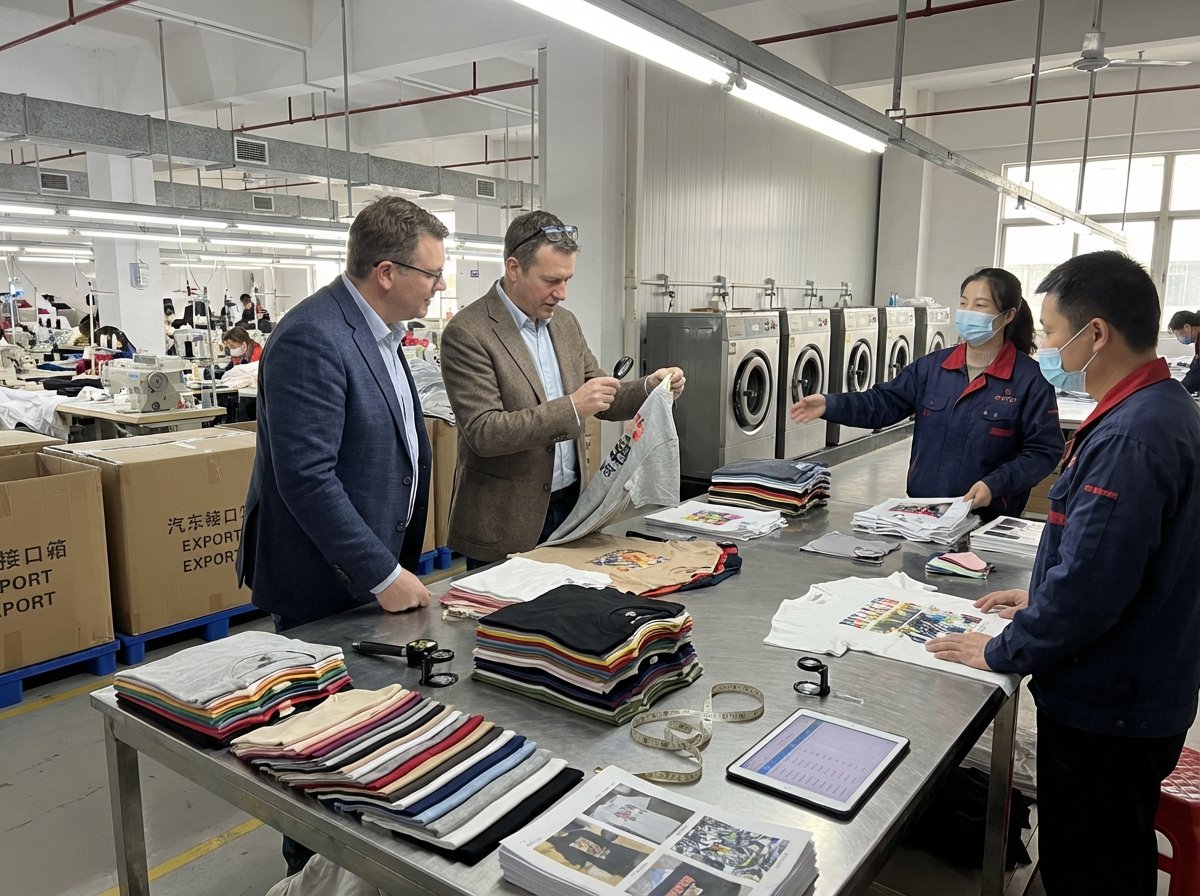
The insight table gives a clear starting point. Buyers complain most about thin fabric, see-through whites, shrinkage, pilling, crooked seams, poor print life, bad collars, and low durability. That means the first factory filter should be technical, not promotional. A strong T-shirt manufacturer should be able to explain fabric weight, opacity control, shrinkage target, print method, neckline construction, size tolerance, and wash testing clearly.
The factory should also show that it understands different product goals. A basic white T-shirt for single wear needs stronger opacity control than a dark color shirt. A fashion blank for embroidery needs more support than a lightweight summer tee. A tall fit tee needs separate length control after washing. A graphic tee needs print elasticity and wash compatibility, not just visual accuracy on day one.
A good factory is also able to repeat. That is where many weak suppliers fail. They can make one good sample, but bulk production drifts in fabric feel, size, print position, or shade. For high-volume orders, repeatability matters more than a pretty first sample.
What Fabric Problems Destroy Wholesale T-Shirt Quality First?
Fabric problems usually appear before sewing, but customers feel them after wearing and washing.
The most common fabric failures are low GSM, poor opacity, unstable shrinkage, weak yarn quality, rough hand feel, and poor surface durability.
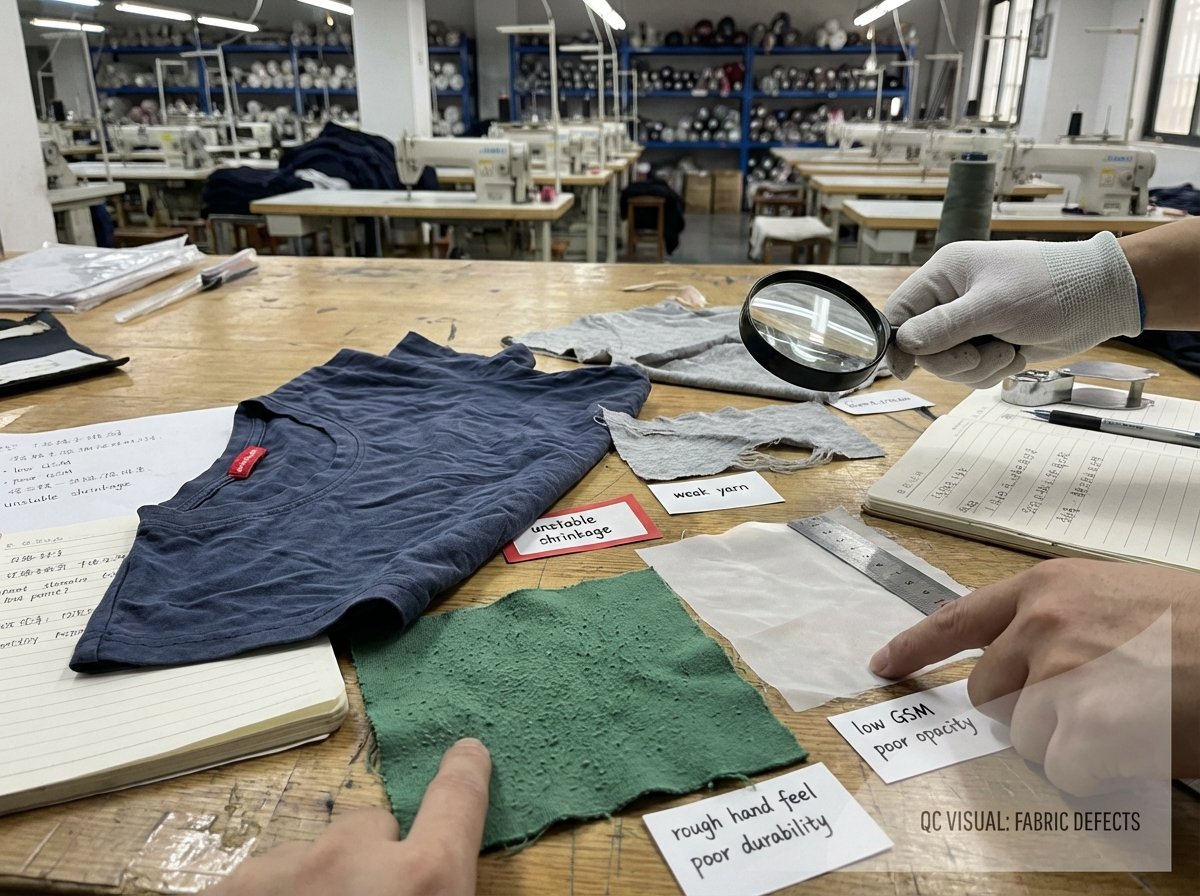
The T-shirt insights make this very clear. Buyers repeatedly complain that shirts are too thin, almost transparent, or so light that the back print or neck label can be seen through the fabric. White and light-colored shirts are the most sensitive here. Buyers also complain that some shirts feel cheap, rough, or plastic-like. Others say the shirts start soft but lose hand feel after washing. These are direct fabric development problems.
A strong factory should not choose fabric only by cost or composition label. It should review GSM, knit density, yarn quality, surface finish, shrinkage behavior, and whether the style is meant for layering or stand-alone wear. A lightweight tee can still work well if it is not see-through and keeps shape. A midweight tee can feel premium if the hand feel is soft and the collar stays stable. A heavyweight tee can create strong value if it feels substantial without becoming stiff.
| Fabric issue from market feedback | Factory-side cause | Better factory response |
|---|---|---|
| See-through white tees | Low GSM or loose knit | Raise GSM and opacity control for white fabrics |
| Shrinkage in length | Weak pre-shrinking | Pre-shrink fabric and monitor wash shrinkage |
| Pilling after a few washes | Hairy yarn or weak finish | Improve yarn quality and anti-pilling finish |
| Rough feel | Poor yarn or finishing | Upgrade yarn and softening process |
| Tiny holes | Weak fabric strength or abrasion resistance | Improve yarn strength and wear durability |
What Key Factors That Affect Cost in High-Volume Custom Apparel Production Matter Most?
Cost in wholesale T-shirt production is shaped by product structure, not just unit count.
The biggest cost drivers are fabric, print method, garment construction, labeling, packaging, testing, and order complexity across colors and sizes.
Fabric is usually the largest cost block. A lightweight promotional tee, a midweight retail tee, and a heavyweight premium graphic tee all sit in very different cost zones. Cotton-rich or premium cotton yarns often raise the cost. Better opacity in white shirts may also increase cost because more structure or weight is needed. The same is true for garment dye, specialty wash, or soft-touch finishing.
Print cost also matters. A simple one-color chest logo is very different from a large multicolor graphic, oversized back print, puff print, or print with strong wash resistance requirements. Sewing cost usually looks smaller than fabric cost, but quality complaints show how important it is. Weak hems, loose neck seams, and open sleeve joins come from labor quality and process control. Labels, fold method, polybags, hangtags, and carton requirements also add cost in large numbers.
The right question is not how to get the lowest cost. The right question is which costs protect product value and which costs can be simplified safely.
How Do Fabric Weight and Opacity Affect Unit Price in Wholesale T-Shirts?
Fabric weight changes both product feel and product risk.
A higher GSM or denser knit usually raises cost, but it also helps solve common wholesale T-shirt problems such as transparency, weak structure, and poor durability.
The market feedback around white and light-colored shirts is especially useful here. Buyers are not only asking for softness. They are asking for shirts that are not see-through. Many negative comments describe white tees as paper-thin, transparent, or impossible to wear without another layer underneath. This means opacity is not a small detail. It is a product-defining feature.
Factories should treat white and light colors differently from dark colors when needed. One fabric spec may not work equally well across all colorways. A stronger wholesale program will often build opacity standards by color family, not just by one general fabric description. That may raise material cost slightly, but it protects the product from one of the most repeated complaints in the T-shirt market.
Why Is Shrinkage Control One of the Most Important Factors in Large T-Shirt Orders?
Shrinkage is one of the fastest ways to destroy fit satisfaction.
A wholesale T-shirt manufacturer should control both width and length shrinkage, with special focus on body length because many buyers notice shirts becoming too short after washing.
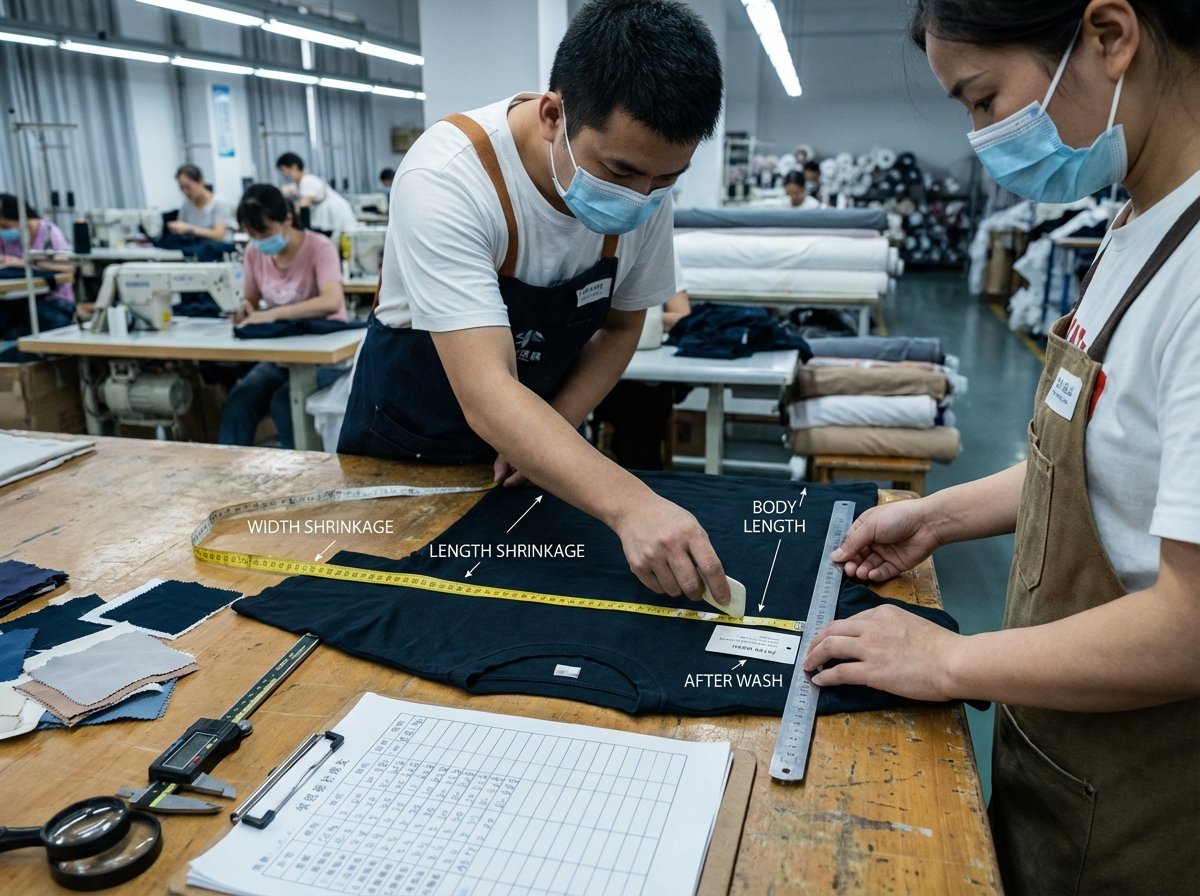
The insight table shows a very clear pattern. Buyers often say cotton shirts shrink mostly in length, not width. Shirts that fit correctly in the store become too short after washing. Tall sizes lose the extra length they were bought for. Some shirts shrink after one wash. Others continue shrinking over multiple washes. That is a serious risk in high-volume production because the complaint hits both regular and tall size programs.
Good factories control this through pre-shrinking, heat setting where appropriate, fabric testing, and wash simulation before bulk approval. They also build realistic shrinkage allowance into patterns where needed. Strong factories do not wait for customers to discover the problem. They test for it during development.
Why Do Fit and Grading Matter So Much in Wholesale Custom T-Shirts?
Fit problems are some of the most visible signs of weak factory control.
A strong T-shirt manufacturer should control body length, sleeve length, neckline balance, shoulder shape, and full size grading so that the shirt feels right in every size.
The market complaints are very specific. Sleeves are too short and dig into the underarm. The body is baggy but the sleeves are still too short. The shirt is too long and loose. The shirt is too short after washing. The neckline is too wide. The shoulder line exposes too much. These are not just “size issues.” They are fit architecture issues.
A good factory should separate fit blocks clearly. Regular fit, relaxed fit, oversized fit, muscle fit, and tall fit should not share one lazy grading logic. A tall size needs more than a wider body. A relaxed fit needs more than extra chest width. A good factory understands this and has pattern control to support it.
| Fit complaint | What it usually means |
|---|---|
| Too short after wash | Shrinkage and length control problem |
| Sleeve too short | Sleeve pattern or grading problem |
| Too boxy | Poor chest-length-shoulder balance |
| Too tight | Incorrect grading or fit block |
| Neckline too wide | Neck shape and shoulder balance issue |
Quality Control Standards for Wholesale Custom T-Shirt Production
Quality control should begin before bulk sewing and continue through final packing.
The most important QC points are fabric GSM, opacity, shrinkage, seam strength, neckline stability, print durability, measurement tolerance, colorfastness, hole prevention, and wash performance.
A strong QC system reflects the real complaint pattern of the market. For T-shirts, that means checking what customers actually punish: see-through fabric, post-wash shrinkage, crooked side seams, cracked prints, fraying necklines, open hems, holes near stress points, faded color, and poor bulk consistency.
This is where the insight table is highly useful. It shows that the same complaints appear across Reddit, Amazon UK, Amazon France, Amazon Germany, Trustpilot, YouTube, Instagram, Facebook, and SiteJabber. That means the failures are not isolated. They are structural. A quality system should therefore include fabric inspection before cutting, print testing before approval, in-line sewing checks, measurement checks during production, and wash simulation before release.
| QC checkpoint | What it protects |
|---|---|
| GSM and opacity check | Prevents thin and see-through shirts |
| Shrinkage test | Prevents post-wash length loss |
| Twist and seam alignment check | Prevents crooked shirts |
| Print wash test | Prevents cracking, peeling, and fading |
| Neckline recovery check | Prevents stretched or frayed collars |
| Seam strength test | Prevents hems and sleeves opening |
| Final measurement check | Prevents size inconsistency in cartons |
What Should Be Checked Before Approving a High-Volume T-Shirt Order?
Bulk approval should be based on evidence, not confidence alone.
Before a wholesale custom T-shirt order is approved, the fabric, fit, print, shrinkage, color, stitching, labels, and packaging standard should all be locked clearly.
This stage matters because many production problems start when sampling and bulk are treated as separate worlds. A sample may feel soft and fit well, but the bulk order may use a different knit lot, a different collar tension, or a weaker print cure. Once the order is cut, the cost of correction rises sharply.
A strong factory will review the approved sample together with the full production standard. That includes fabric lot, print file, print position, measurement chart, seam construction, neck label, fold method, barcode, and carton ratio. If the product includes white tees, graphic tees, or tall sizes, those special risks should be checked even more carefully.
How Can High-Volume T-Shirt Costs Be Reduced Without Damaging Quality?
Cost control works best when it removes waste, not product value.
The safest ways to lower cost are simplifying trim and packaging, consolidating colors, using proven fabric programs, and choosing print methods that fit the order scale.
The insight table shows what happens when cost is cut in the wrong place. White shirts become transparent. Cotton shirts shrink too much. Prints crack. Necklines stretch. Seams open. Tiny holes appear. These are not smart savings. They are future complaints.
Better cost control usually protects the parts customers feel first. Keep enough opacity in white tees. Keep shrinkage under control. Keep collar and hem quality stable. Keep print method aligned with the garment. Then simplify the areas that do not damage product trust, such as excessive packaging layers or unnecessary minor trim variation. In wholesale production, stable simplicity is often more profitable than decorative complexity.
Conclusion
The best wholesale custom T-shirt production combines smart cost control with strict fabric, fit, print, and wash standards. In high-volume orders, stable quality is what protects both margins and long-term customer trust.