
A clothing line business plan explains how a collection becomes a workable business. It connects the customer, product range, manufacturing arrangements, selling prices, sales channels, and cash required to operate.
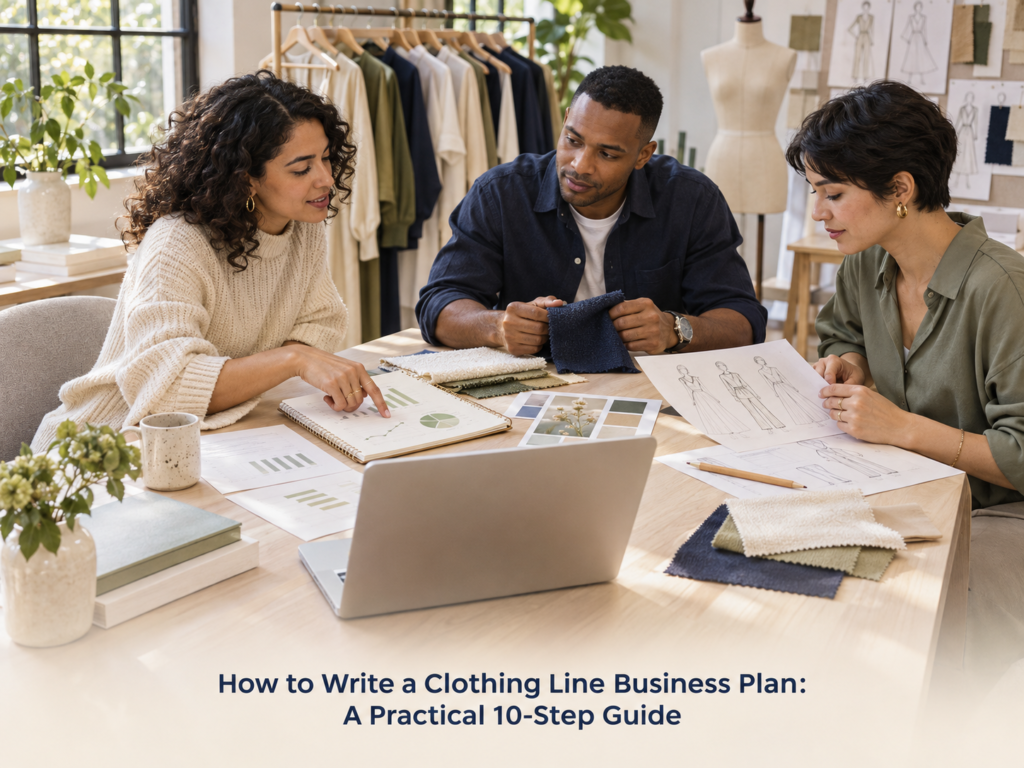
For a fashion brand, those decisions are closely linked. Adding another color creates more inventory. A custom fabric may change the minimum order. Selling wholesale changes the revenue received per garment. A delayed sample can affect photography, production, and the launch date.
A useful plan makes these connections visible before money is committed. It should help you decide what to produce, how much to order, where to sell, and when to invest in the next collection.
The following ten steps provide a practical structure for writing a clothing line business plan, with particular attention to product development, manufacturing, and financial planning.
What Should a Clothing Line Business Plan Include?

The plan should explain the business clearly enough for someone outside the company to understand how it will operate. It also needs enough detail to guide internal decisions.
Core subjects include the company, target customers, product range, market evidence, sourcing, sales, marketing, operations, and financial forecasts.
The format depends on its purpose. An internal planning document can be concise and updated frequently. A plan prepared for a funding discussion may need more detailed projections and supporting evidence.
Keep assumptions identifiable. Separate confirmed quotations and actual sales from estimates, proposed arrangements, and goals. Readers should be able to trace important figures to their source.
Step 1: Write an Executive Summary
Place the executive summary at the beginning, but finalize it after the other sections. It should reflect the decisions and numbers developed in the full plan.
Explain what the business sells, who it serves, how it reaches customers, and what makes the product worth buying. Include the current stage: concept development, sampling, first production, or established sales.
A concise example might read:
The business will launch a small range of casual knitwear for customers seeking consistent fits and understated branding. Initial sales will come through a direct online store. The first collection will use approved materials and a limited color range, with replenishment based on product-level sales and returns.
That description needs supporting detail elsewhere. State the funding requirement and intended use if funding is being sought.
Avoid unsupported phrases such as “a brand for everyone” or “guaranteed rapid growth.” The summary should communicate a specific commercial proposition.
What to include: the customer, lead products, sales model, launch stage, principal advantage, and immediate business objective.
Step 2: Define the Company and Brand Position
Describe the business structure, ownership, location, and responsibilities. Identify the people managing design, sourcing, finance, marketing, and customer operations, including functions handled by external specialists.
A small team can cover several roles. The plan should show who makes decisions and where capability still needs to be added.
Then define the brand’s position. Consider the intended price level, product character, fit approach, customer experience, and standards the collection must meet.
Replace broad promises with product decisions. “Quality basics” might mean an approved jersey specification, a consistent measurement system, defined care performance, and controlled repeat production.
Explain how the brand identity supports those choices. Naming, packaging, photography, and communication should represent the same proposition as the clothing.
Record relevant business setup tasks and who is responsible for confirming requirements in the intended markets. Keep unresolved work visible rather than presenting it as completed.
This section establishes what the company is building and how the team is equipped to deliver it.
Step 3: Research the Customer and Competitive Market
Define the customer through purchasing behavior as well as demographics. Explain what they buy, where they shop, what they pay, and which occasions the clothing serves.
For example, a customer buying a fitted studio top has different priorities from someone purchasing a heavyweight graphic hoodie. Their product comparisons and reasons for returning an item may also differ.
Build a focused competitor comparison using relevant products at the price level you intend to enter. Review fit, materials, sizing, delivery, returns, presentation, and customer feedback.
Speak with potential buyers and record the evidence. Questions about their last purchase often reveal more than asking whether they like a proposed collection.
Use findings to identify a defensible opportunity. Repeated complaints about inconsistent length, limited size guidance, or an uncomfortable waistband can inform product development.
Distinguish interest from demand. Social engagement, mailing-list signups, test purchases, and repeat orders represent different levels of commitment.
End this section with the customer need, the available alternatives, and the evidence supporting your response. Broad market-growth figures can provide context, but they do not establish demand for your particular products.
Step 4: Build the Product and Collection Plan
Describe the first range at style level. Include category, intended fit, material direction, colors, sizes, target selling price, and planned quantity.
| Product decision | What the plan should establish |
|---|---|
| Lead product | The item expected to introduce customers to the brand |
| Supporting styles | Products that complete an outfit or serve another clear need |
| Size range | Measurements, development scope, and initial size quantities |
| Colors | A controlled selection supported by the customer research |
| Development | Technical packs, patterns, samples, and testing needed |
| Replenishment | Which styles may continue and which are limited releases |
Count the inventory variants. Four styles in three colors and five sizes create 60 stock-keeping units. Even a visually small collection can spread the order across many separate stock positions.
Assign each style a role. Explain why it belongs in the launch and what evidence would justify a reorder.
Avoid treating the first range as a full catalog. Products can be added after fit, demand, and operations have been tested.
Include development status. A sketched design, a quoted product, and an approved production sample carry different levels of certainty.
Step 5: Plan Sourcing and Manufacturing
Explain how the garments will be developed and produced. Options may include decorated existing styles, private label arrangements, or custom cut-and-sew manufacturing.
Clarify the scope rather than relying on terminology. Private label clothing can involve custom development; the quotation needs to identify exactly what is supplied.
Document material sourcing, pattern making, sampling, grading, decoration, labels, packaging, and quality checks. Identify the party responsible for each.
Request quotations against a consistent brief. Confirm quantities per style and color, material references, included services, payment terms, and delivery basis.
Minimum order quantities need particular attention. A garment minimum may differ from the minimum purchase for custom fabric, labels, or hardware. Ask how unused components will be charged and managed.
Plan sampling before fixing the production calendar. Include review time and the possibility of revisions. Approval should identify the sample, measurements, materials, artwork, and finishing requirements.
Through Yoplook’s material sourcing service, brands can discuss fabric and trim options around the proposed product.
The business plan should summarize the agreed manufacturing approach and attach detailed quotations or specifications as supporting evidence. Mark provisional supplier arrangements clearly.
Step 6: Choose Sales Channels and Organize Fulfillment
Describe where sales will happen and how orders will reach customers.
A direct online store provides one operating model. Wholesale to retailers creates another, with different prices, payment timing, order sizes, and service requirements. Marketplaces, events, and pop-ups introduce additional fees and operational work.
Choose channels you can support rather than listing every possibility. Explain the role of each and how much revenue the forecast expects from it.
For fulfillment, define storage, receiving, stock records, picking, packing, shipping, returns, and customer support. Identify whether these activities are handled internally or outsourced.
Plan how returned products are inspected and recorded. Some may be resalable; others may need repair, discounting, or write-off. Those outcomes affect available inventory and costs.
Make product information part of operations. Accurate size charts, fit notes, care instructions, and delivery expectations help customers make informed choices.
Include channel-specific costs in the financial model. A wholesale sale and a direct sale of the same garment should not automatically be assigned identical revenue or selling expenses.
Step 7: Create a Marketing Plan With Measurable Assumptions
Connect marketing to the customer research and selling model.
Explain how buyers will discover the brand, evaluate the product, and receive reasons to return. Choose activities that support those stages.
For a new range, fit demonstrations, material close-ups, styling examples, and clear product explanations may help communicate the offering. Partnerships should be assessed by audience relevance and measurable results.
Build a calendar around product readiness. Photography, launch emails, and retailer presentations need suitable samples and reliable information.
For each activity, record the objective, responsible person, budget, and measure of success. Separate brand awareness from immediate sales generation.
Track the cost of acquiring customers alongside the contribution their orders generate. Strong revenue growth can still consume cash if marketing expenditure rises faster than the value of the orders.
Avoid assuming every customer will reorder. Use observed repeat-purchase behavior when it becomes available and treat earlier estimates as assumptions.
The plan should explain how marketing will be tested, reviewed, and adjusted. Spending more becomes a decision supported by results rather than an automatic response to slow sales.
Step 8: Set Prices and Calculate Product Economics
Begin with the cost of getting sellable inventory to its intended storage location. Establish which manufacturing, freight, duty, and related costs belong in the landed product cost, using consistent accounting treatment.
Then identify variable costs associated with selling: payment fees, fulfillment, shipping subsidies, commissions, and attributable marketing where appropriate.
Gross margin and contribution answer different questions.
Gross margin = (net sales revenue − cost of goods sold) ÷ net sales revenue
Contribution = net sales revenue − cost of goods sold − other variable selling costs
Gross profit still needs to support selling and operating expenses. It is not the same as net profit.
An Illustrative Calculation
Assume one kept item sells for $40 after discounts, its allocated landed cost is $14, and other variable selling costs total $8. This simplified example excludes tax and assumes no refund.
| Item | Hypothetical amount |
|---|---|
| Net sales revenue | $40 |
| Landed cost of the item sold | $14 |
| Gross profit | $26 |
| Gross margin | 65% |
| Other variable selling costs | $8 |
| Contribution toward fixed costs | $18 |
The $18 contribution still needs to support fixed operating costs. Returns, discounts, or higher acquisition costs would change the result.
For a single-product illustration:
Break-even units = fixed costs ÷ contribution per unit
At $3,600 in fixed costs for the same period and $18 contribution per unit, break-even is 200 units. A mixed collection needs a calculation that reflects its actual or assumed sales mix.
These figures are examples, not manufacturing quotations or recommended margins. Use confirmed costs and realistic selling assumptions for your business.
Step 9: Forecast Sales, Cash Flow, and Funding Needs
Build the sales forecast from quantities and expected realized prices by channel. Explain the basis for those quantities.
For direct online sales, traffic, conversion, orders, and units per order can help structure the forecast. For wholesale, use realistic account development, order values, payment terms, and delivery dates.
Keep units consistent. Five hundred orders do not equal five hundred garments if customers buy more than one item.
Prepare a monthly cash forecast for the launch and operating period. Show when money is received and when it leaves the business.
Production deposits, balance payments, freight, and inventory purchases may happen well before the associated customer receipts. Inventory purchases create cash outflow even though unsold goods are not all recognized as cost of goods sold immediately.
Include samples, testing, photography, software, storage, fulfillment, marketing, founder compensation where applicable, and other operating commitments.
Prepare at least a base case and a slower-sales case. Examine what happens if approval takes longer, returns exceed expectations, a shipment arrives late, or replenishment requires payment before the first order has sold through.
For a funding requirement, identify the largest forecast cash shortfall, the available funding, and the reserve needed for identified uncertainty. Explain what additional funds would be used for.
Keep financing receipts separate from trading revenue. Also distinguish cash flow from profitability: either can look positive while the other remains under pressure.
Step 10: Set Milestones, Responsibilities, and Review Rules
Turn the plan into a schedule of decisions and deliverables.
| Milestone | Evidence required before proceeding |
|---|---|
| Range approval | Defined products, customer rationale, and target costs |
| Sample approval | Agreed fit, materials, construction, and relevant test results |
| Bulk order | Confirmed specifications, quantities, quotation, and funding |
| Launch readiness | Stock or supported delivery plan, product content, and fulfillment |
| Reorder decision | Product-level sales, returns, contribution, and cash availability |
Assign an owner and target date to each milestone. Identify dependencies so one delay does not remain hidden until launch.
Include a short risk register. Focus on issues that could change a decision, such as material availability, concentrated supplier dependence, weak size demand, or an unproven acquisition channel.
Define review rules before results arrive. For example, the team might investigate a recurring fit complaint before repeating production or require a revised cash forecast before expanding the range.
Write the executive summary again once these decisions are settled. It should describe the resulting business accurately.
Keep an Assumptions Register
Maintain a short table alongside the forecast showing each important assumption, its evidence, the person responsible for checking it, and the next review date.
For example, distinguish a quoted garment cost from an estimated freight allowance. Record whether a sales conversion assumption comes from your own store, a small test, or an unvalidated target.
Use this register to prioritize work. If the plan is highly sensitive to returns, improve fit testing and customer information before adding styles. If freight or material costs remain uncertain, obtain updated quotations before approving the order.
Review Inventory Quality, Not Just Inventory Value
The total value of stock can conceal an unhealthy mix. A collection may have ample inventory while its most requested size is unavailable.
Review stock by style, color, and size alongside the sales rate and expected replenishment time. Separate sellable stock from damaged goods and returns awaiting inspection.
This makes the next purchase a product-level decision instead of a repeat of the original order.
A Clothing Line Business Plan Checklist
Before using the plan to approve spending or discuss funding, check that it answers the following:
- Who buys the clothing, and what evidence supports that view?
- What will the first collection contain?
- Which development and production arrangements are confirmed?
- What does each channel contribute after relevant variable costs?
- When are supplier payments and customer receipts expected?
- How will inventory, returns, and reorders be managed?
- Who owns the next decisions?
- Which assumptions would materially change the plan?
Keep detailed evidence in an appendix: quotations, range sheets, sample records, research notes, and forecast assumptions.
The document should remain readable. Move technical detail into supporting material without losing the decisions it informs.
Common Mistakes in Clothing Brand Business Plans
Forecasting from the size of the global market. A small claimed market share is not a customer-acquisition strategy. Build the forecast from reachable buyers and realistic sales activity.
Confusing a low unit price with a low commitment. A larger minimum order may reduce unit cost while increasing cash tied up in stock.
Applying one margin to every channel. Selling prices, fees, returns, and fulfillment differ.
Counting all inventory as immediately sold. Include the possibility of slow sizes, colors, and seasonal products.
Presenting estimates as confirmed facts. Label assumptions and revise them when evidence arrives.
Treating the plan as finished at launch. Actual sales and production experience should improve the next version.
How Yoplook Supports the Manufacturing Plan
Yoplook is a custom clothing manufacturer supporting T-shirts, hoodies, tracksuits, sportswear, dresses, denim clothing, and other apparel categories.
Our manufacturing services connect fabric sourcing, pattern development, sampling, garment production, printing, embroidery, labels, and packaging. Brands can use the development process to confirm product requirements before committing to bulk quantities.
Through our private label clothing manufacturing service, we review projects around their designs, materials, quantities, and branding requirements.
A useful inquiry includes product references or a tech pack, fabric preferences, size range, quantities by color, and delivery requirements. This creates a clearer basis for discussing feasibility, sampling, and quotation.
Frequently Asked Questions
How long should a clothing line business plan be?
Long enough to explain the decisions and evidence. An internal plan may be short, while a funding discussion may require detailed forecasts and supporting documents.
Can I write the plan before selecting a manufacturer?
Yes. Use provisional assumptions initially, then replace important production estimates with quotations and sample findings before committing to stock.
Do I need a separate plan for every collection?
Usually, the main business plan can include collection-specific range plans and budgets. Update the wider assumptions when the sales model or operating structure changes.
How often should the plan be reviewed?
Review it at major commitments and when actual results differ materially from assumptions. During launch, frequent financial and inventory reviews are useful.
Build a Plan You Can Use
A strong clothing line business plan links customer demand to product decisions, manufacturing, sales, and cash. Its value comes from making those relationships clear enough to guide action.
Start with a focused range, support estimates with evidence, and update the plan as development and sales provide better information. Contact Yoplook to discuss the manufacturing requirements behind your next collection.