
A cotton T-shirt can look fine in a sample, but the wrong GSM can lead to see-through fabric, weak shape, fast wear, bad print results, and disappointing wash performance.
The right GSM for a cotton T-shirt depends on product position, color, fit, season, and end use. Better GSM choice helps control opacity, comfort, durability, print stability, and customer expectations before sampling and bulk production begin.
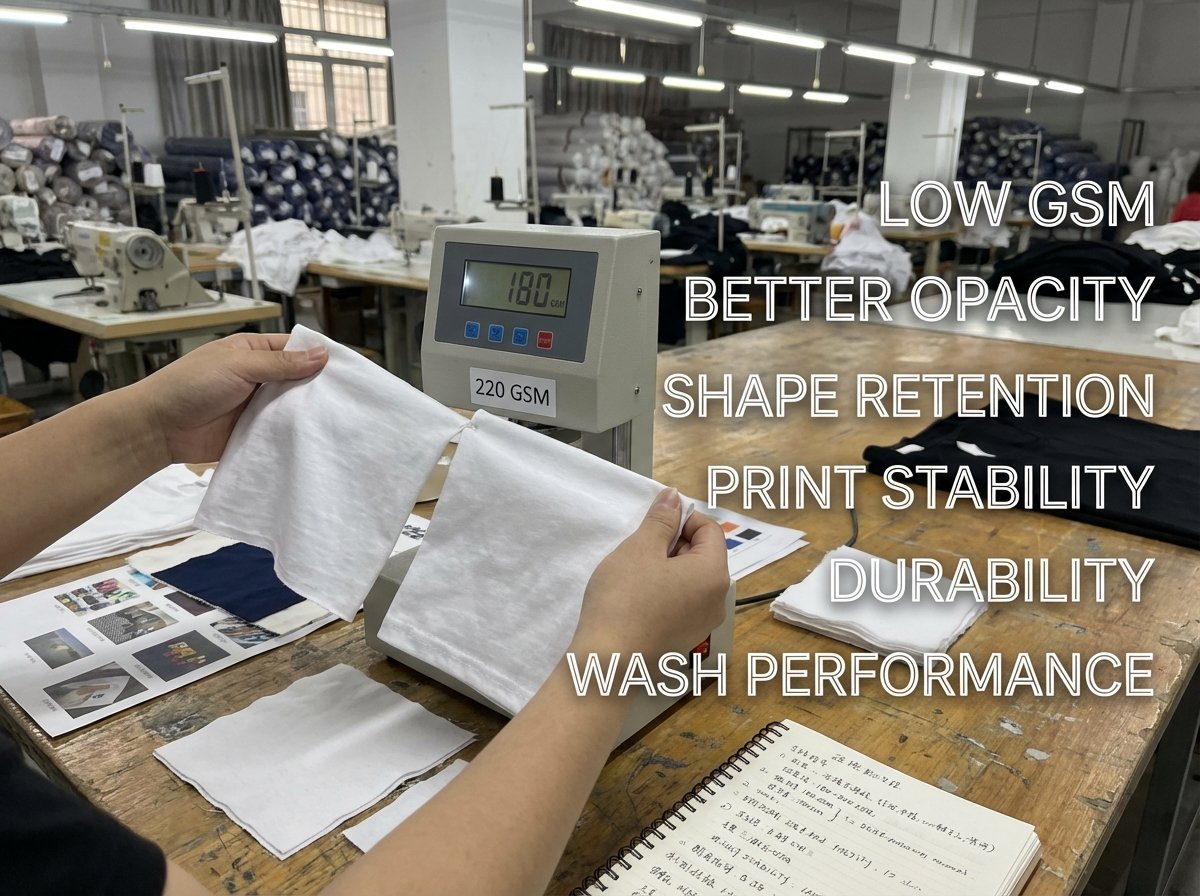
GSM is one of the most important decisions in T-shirt development, yet it is often treated as a simple number. In real production, GSM affects much more than weight. It changes how a shirt feels in the hand, how it drapes on the body, how much it covers, how it performs after washing, and whether it matches the product promise on the page. Real market feedback shows the same problems again and again. White T-shirts are too thin and transparent. Cotton tees shrink and become too short. Light jerseys lose shape. Cheap-looking shirts pill quickly. Thin blanks fail under embroidery. Some shirts feel soft on day one but lose structure after washing. Many of these problems connect directly to fabric weight and how that weight is used in development.
That is why GSM should not be chosen by habit alone. A 160 GSM cotton tee, a 200 GSM cotton tee, and a 260 GSM cotton tee may all be called “cotton T-shirts,” but they do not behave like the same product. A better GSM decision helps reduce sampling mistakes, improve bulk consistency, and make sure the finished shirt fits the real use case.
What Does GSM Mean in Cotton T-Shirt Development?
GSM is the fabric weight per square meter, but in T-shirt development it works as a product signal, not only a lab measure.
For cotton T-shirts, GSM influences opacity, drape, structure, hand feel, warmth, durability, and how premium or cheap the shirt feels at first touch.
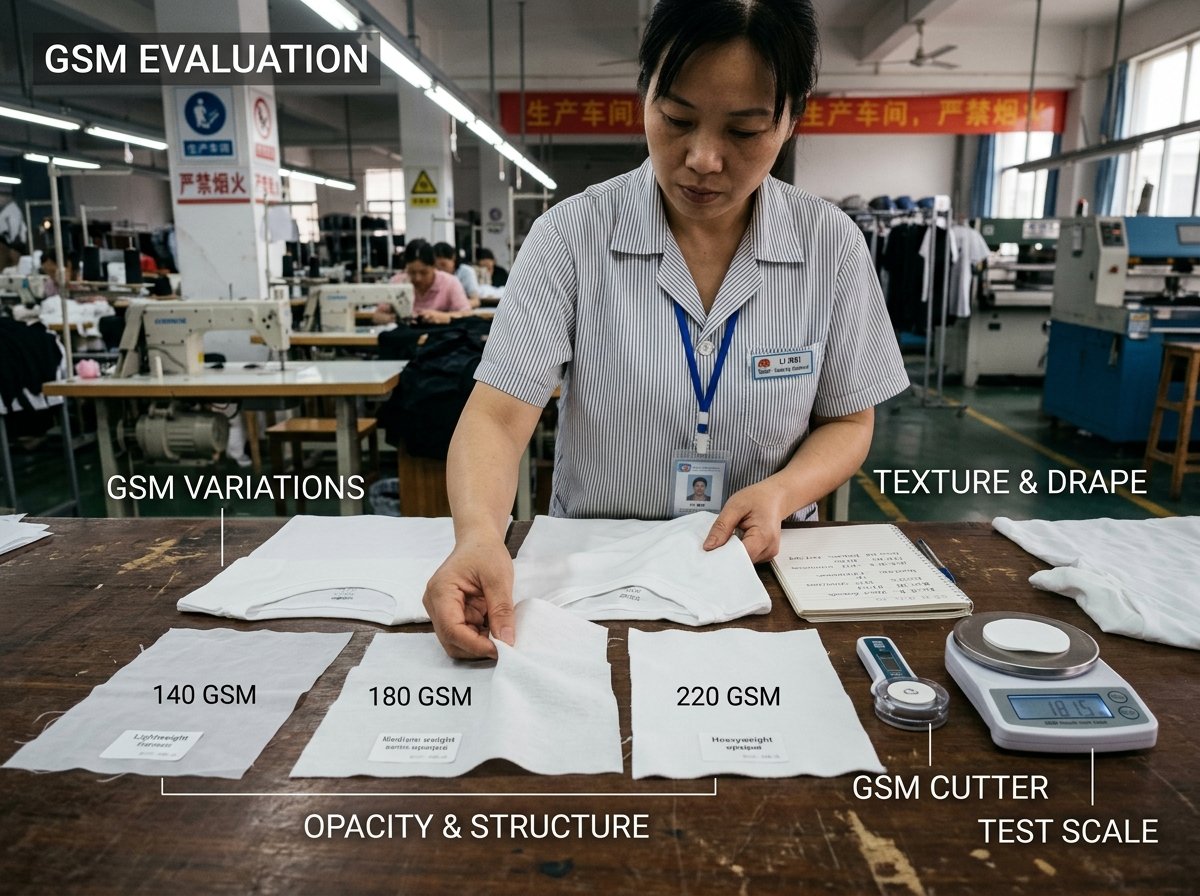
Many buyers know GSM as a technical term, but end customers feel it through experience. When people say a shirt feels paper-thin, too light, too flimsy, too transparent, or too weak to hold a print, they are often reacting to a GSM decision. When they say a shirt feels substantial, premium, durable, not see-through, and able to keep shape after washing, GSM is usually part of that result too.
Still, GSM should never be read alone. A 180 GSM tee with poor yarn and loose knit can feel weaker than a better-built 170 GSM tee. A 200 GSM white tee may still show through if opacity is poorly controlled. A heavier shirt may feel stiff if the yarn and finishing are wrong. GSM matters a lot, but it works together with yarn quality, knit density, finishing, shrinkage control, and color.
| GSM range | General feel | Common market impression |
|---|---|---|
| 120–160 GSM | Light | Cool, but often risky for opacity and shape |
| 160–190 GSM | Mid-light to midweight | Balanced for many everyday tees |
| 190–220 GSM | Midweight to premium | Better structure and stronger value feel |
| 220+ GSM | Heavyweight | Substantial, durable, more structured |
How GSM Affects T-Shirt Quality, Comfort, and Use Case
GSM affects quality because it changes how much support the fabric gives the garment.
In cotton T-shirts, better GSM choice improves comfort, opacity, print support, shape retention, and long-term wear, while the wrong GSM often creates complaints about thinness, distortion, or weak value.
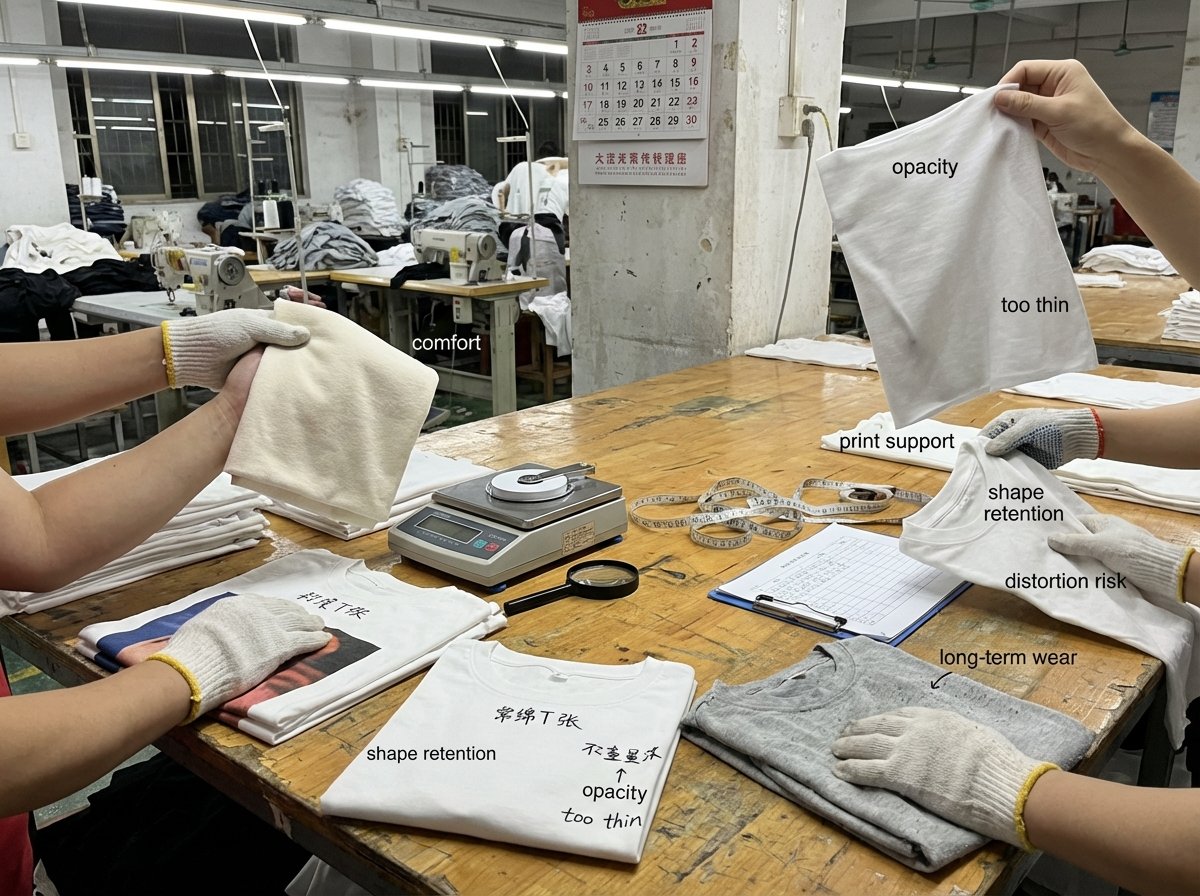
The insight table makes this very clear. One of the biggest complaint groups is about shirts that are too thin or fully see-through, especially in white and lighter colors. Buyers say the fabric feels cheap, the shirt needs another layer underneath, or even the inside neck print can be read from the outside. These are direct warnings that the GSM or knit structure is too weak for the intended use.
GSM also affects comfort in different ways. A lighter fabric may feel cooler and more breathable in hot weather, but if it becomes clingy, transparent, or unstable after washing, the comfort benefit disappears. A midweight or slightly heavier cotton tee often feels more secure on the body and gives better drape, but if it is too heavy for the season or market, it may feel bulky. Good product development matches GSM to the real wearing context instead of chasing one number for everything.
GSM also influences perceived quality. Many positive reviews praise shirts that are soft but substantial, lightweight but not see-through, or thick without feeling rough. That balance usually starts with better GSM choice.
Why Do Thin Cotton T-Shirts Create So Many Complaints?
Thin cotton T-shirts fail when the product promise is stronger than the fabric can support.
Low GSM cotton tees often create the most complaints around transparency, weak shape, tiny holes, collar instability, poor print support, and a cheap overall feel.
The pain points repeat across Reddit, Amazon UK, Amazon France, Amazon Germany, Trustpilot, YouTube, Instagram, Facebook, and SiteJabber. White shirts are described as paper-thin. Light-colored tees are said to be fully transparent. Some buyers can see body tattoos or printed neck labels through the fabric. Others say the shirt becomes distorted, stretches out, or develops small holes after washing and wearing. In many cases, the shirt is not only light. It is underbuilt.
This does not mean every lightweight cotton tee is bad. There is real demand for light, breathable shirts. The problem starts when a lightweight fabric is used for the wrong product position. A low GSM tee may work as a layering base, sleep shirt, or hot-weather casual tee if it still has enough knit density and quality. It fails when it is sold as a premium single-wear white tee, a durable graphic tee, or a blank expected to support embroidery and repeated washing.
Best GSM Options for Different T-Shirt Product Positions
There is no single best GSM for every cotton T-shirt.
The best GSM depends on whether the shirt is meant for layering, daily basics, premium retail, heavyweight streetwear, graphic printing, or white single-wear use.
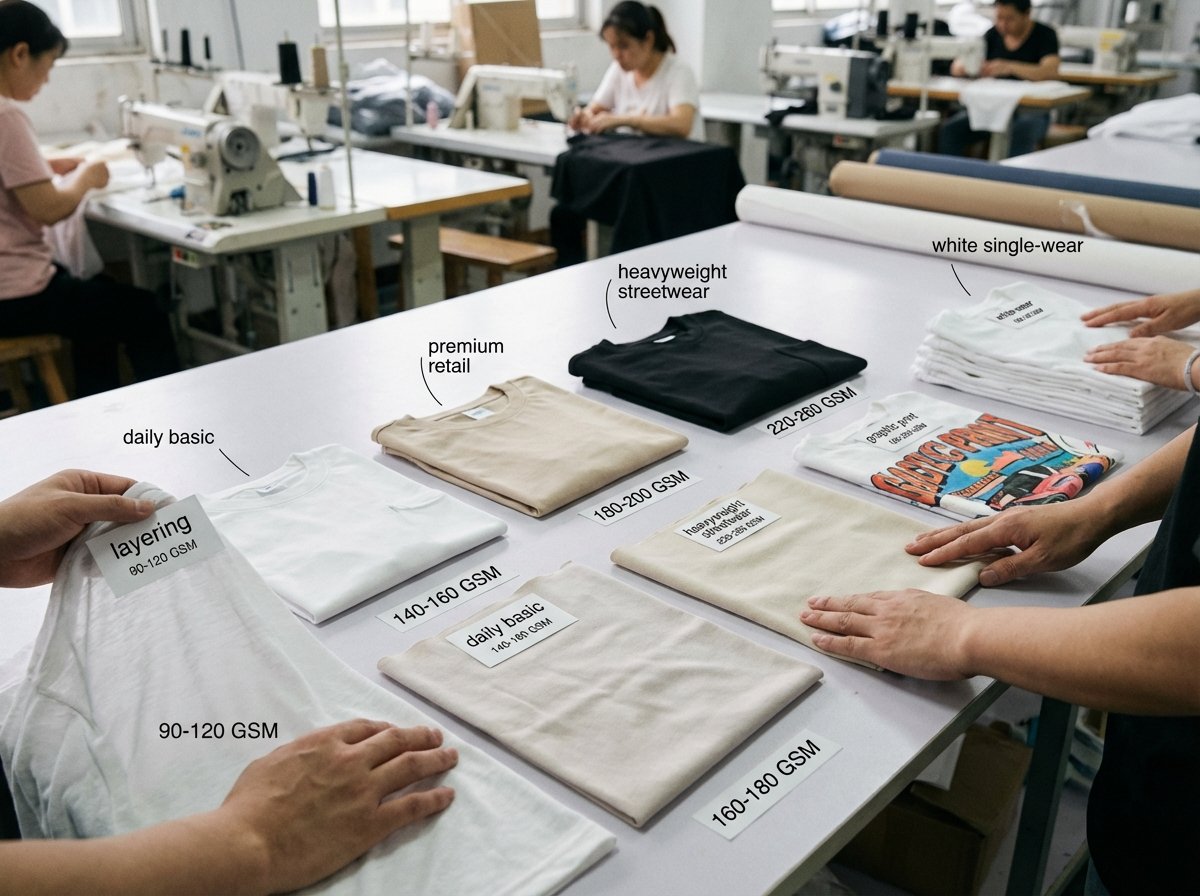
A light summer layering tee usually performs better in a lower GSM range, but it still needs enough opacity and recovery. An everyday basic retail tee often works best in the balanced midweight range. A premium blank or stronger single-wear white tee usually benefits from a higher GSM and more structure. A heavyweight streetwear tee needs an even higher GSM, but the fit, shoulder, collar, and softness must still support the look.
A practical way to think about it is by product role:
| Product position | Common GSM direction | Why it works |
|---|---|---|
| Lightweight layering tee | 140–160 GSM | Lighter feel for layering and heat |
| Everyday basic cotton tee | 160–190 GSM | Good balance of comfort and value |
| White tee for single wear | 180–220 GSM | Better opacity and cleaner drape |
| Graphic tee with stronger print support | 180–220 GSM | Better base for printing and durability |
| Heavyweight fashion or streetwear tee | 220–280 GSM | Strong structure and premium substance |
These are not fixed rules. A well-made 170 GSM white tee may work better than a weak 190 GSM one. Still, the table helps avoid the biggest mismatch: using an underweight fabric for a product that needs coverage, structure, and wash confidence.
How Should White Cotton T-Shirts Be Treated Differently?
White cotton tees should almost never be developed exactly the same way as dark colors.
White shirts need stronger opacity control, and in many cases they need a better GSM or denser knit than darker colors to avoid transparency complaints.
The insight table shows that white and light-colored shirts get some of the harshest criticism. Buyers repeatedly say white shirts are see-through, too thin, or impossible to wear alone. This is one of the clearest signs that color-sensitive GSM planning matters.
A fabric that works well in black, navy, or charcoal may fail badly in white. Dark shades naturally hide the body better. White does not. That is why strong T-shirt programs often separate white specifications from dark-color specifications. Even when the stated GSM stays close, the opacity target, knit compactness, and acceptance standard should not be the same.
For white graphic tees, the demand is even higher. Buyers want the shirt to be breathable but not transparent. They also want the print to sit well on the surface without making the fabric collapse or look cheap. That usually requires a more careful GSM decision.
How Does GSM Affect Printing, Embroidery, and Decoration?
GSM affects how well the blank can carry decoration without looking weak or distorted.
Lower GSM tees often struggle more with embroidery support, print stability, and surface tension, while better GSM choices usually improve decoration results and wash life.
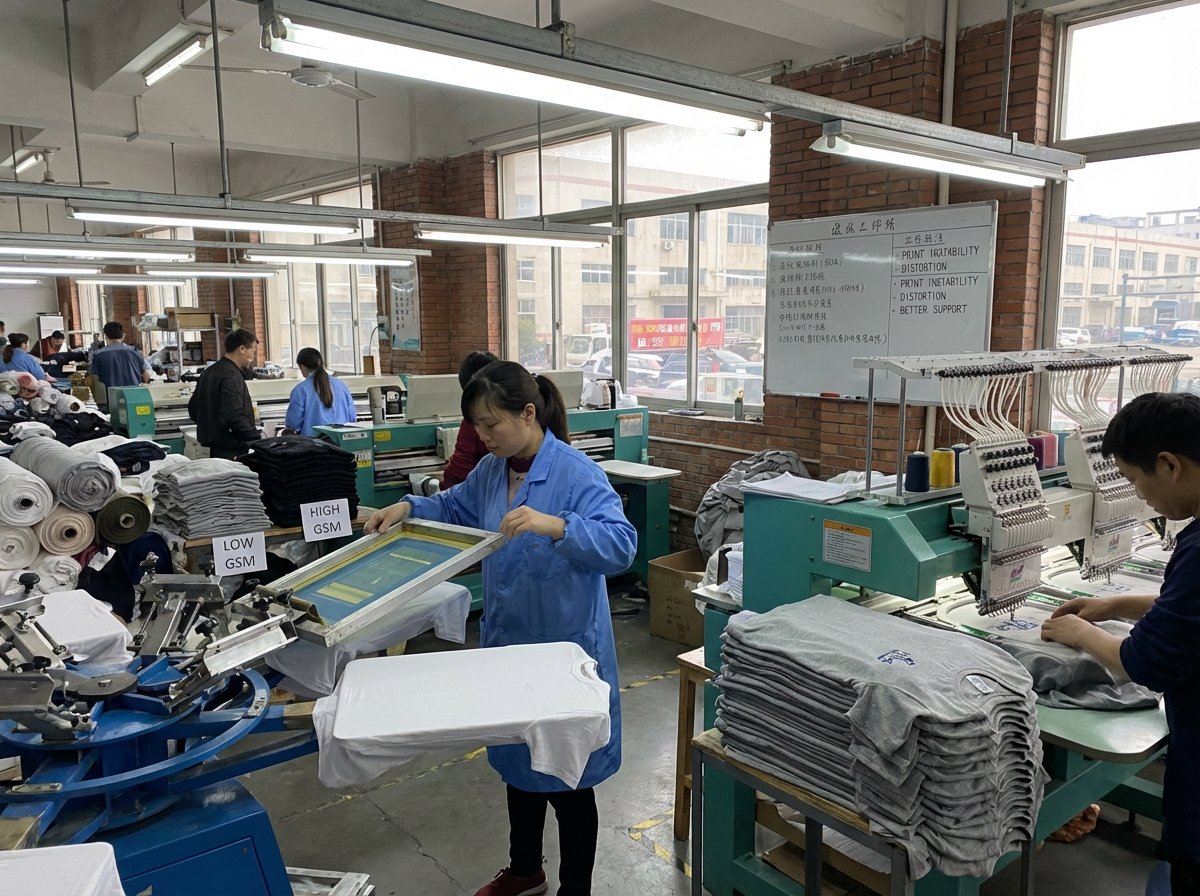
The insight table shows many print-related complaints. Prints crack, peel, fade, or feel papery. Some embroidered or decorated tees look wrong because the fabric is too thin to carry the work cleanly. This is one reason why a fabric should never be chosen by hand feel alone.
A very light cotton tee may work for minimal prints, but it can become unstable with heavier design applications. Embroidery especially needs a more supportive base. Large graphics also behave better when the blank has enough body and shrinkage stability. If the fabric shrinks too much or loses shape, the print can crack or distort faster.
This is why GSM selection should always be connected to the decoration plan. A shirt developed for blank retail is not always the same shirt that should be used for heavy custom graphics or embroidery programs.
How Buyers Should Specify GSM to Avoid Sampling and Production Mistakes
GSM should be specified as part of a full fabric standard, not as a loose target.
To avoid mistakes, buyers should define GSM together with color use, cotton type, knit structure, opacity expectation, shrinkage standard, and intended product position.
One of the biggest sourcing mistakes is giving only one number and assuming the fabric outcome is already clear. A request for “180 GSM cotton jersey” is often not enough. That number does not explain whether the shirt is for white single wear, dark graphic print, oversized fashion, tall basics, or lightweight summer use. It also does not explain how much shrinkage is acceptable after washing, how compact the knit should feel, or whether softness should be prioritized over structure.
A better specification is more practical. It should tell the factory what the shirt needs to do. For example, the shirt may need to be a white crewneck for stand-alone wear, not see-through, soft hand feel, regular fit, minimal shrinkage, print-friendly, and stable after multiple washes. That kind of direction helps the factory build the right GSM solution instead of guessing.
| Weak GSM request | Better GSM request |
|---|---|
| 180 GSM cotton tee | 180–190 GSM cotton tee for white single wear, soft but not see-through, regular fit, low shrinkage |
| 160 GSM blank tee | 160–170 GSM layering tee, breathable, light hand feel, not for heavy embroidery |
| 240 GSM heavy tee | 230–250 GSM structured cotton tee for oversized fit, strong collar, good drape, durable wash performance |
What Sampling Problems Happen When GSM Is Chosen Poorly?
Poor GSM choice causes sampling errors that often look like fit or finishing problems at first.
Common sample-stage problems include fabric feeling cheaper than expected, poor opacity, wrong drape, unstable print results, weak collar balance, and post-wash length loss.
This is where many T-shirt programs lose time. A buyer may think the pattern is wrong because the shirt feels limp. The factory may think the print method is wrong because the graphic looks too harsh. The real issue may be that the base fabric is too light for the product direction. In other cases, the shirt may look acceptable before washing but come back too short, twisted, or visually weaker after wash testing.
This is why GSM should be decided before too many trim and fit revisions begin. If the fabric weight is wrong, many later comments will only treat the symptom, not the cause. A better GSM decision early in development usually leads to cleaner sampling, fewer revisions, and stronger bulk accuracy.
How Should GSM Be Balanced with Softness and Durability?
Softness and durability should not be treated as opposites.
The strongest cotton T-shirts often combine a suitable GSM with better yarn quality, cleaner knitting, and better finishing, so the shirt feels soft without becoming weak or flimsy.
The positive side of the insight table is useful here. Buyers repeatedly praise shirts that are soft and durable, lightweight but not see-through, substantial but comfortable, thick and soft, or able to hold shape wash after wash. That shows the market does not want one extreme only. It wants balance.
A heavier tee is not automatically better if it feels hard. A soft tee is not automatically better if it pills, shrinks, or becomes transparent. Better GSM choice works when it supports the real experience buyers want: comfort, confidence, and product life. That is why the best T-shirt programs do not chase the lightest or heaviest number. They choose the number that supports the target product honestly.
Conclusion
Better GSM choice helps cotton T-shirts feel right, wear better, print cleaner, and match customer expectations more closely. The best GSM is not one fixed number, but the one that fits the product position, color, decoration method, and real use case without creating avoidable quality problems.