
A hoodie may look simple, but one weak factory decision can lead to shrinkage, pilling, loose cuffs, broken zippers, and fast customer complaints.
The best hoodie manufacturer in 2025 is a factory that can keep fit, fabric feel, wash performance, stitching strength, color stability, and bulk consistency under control from development to shipment.
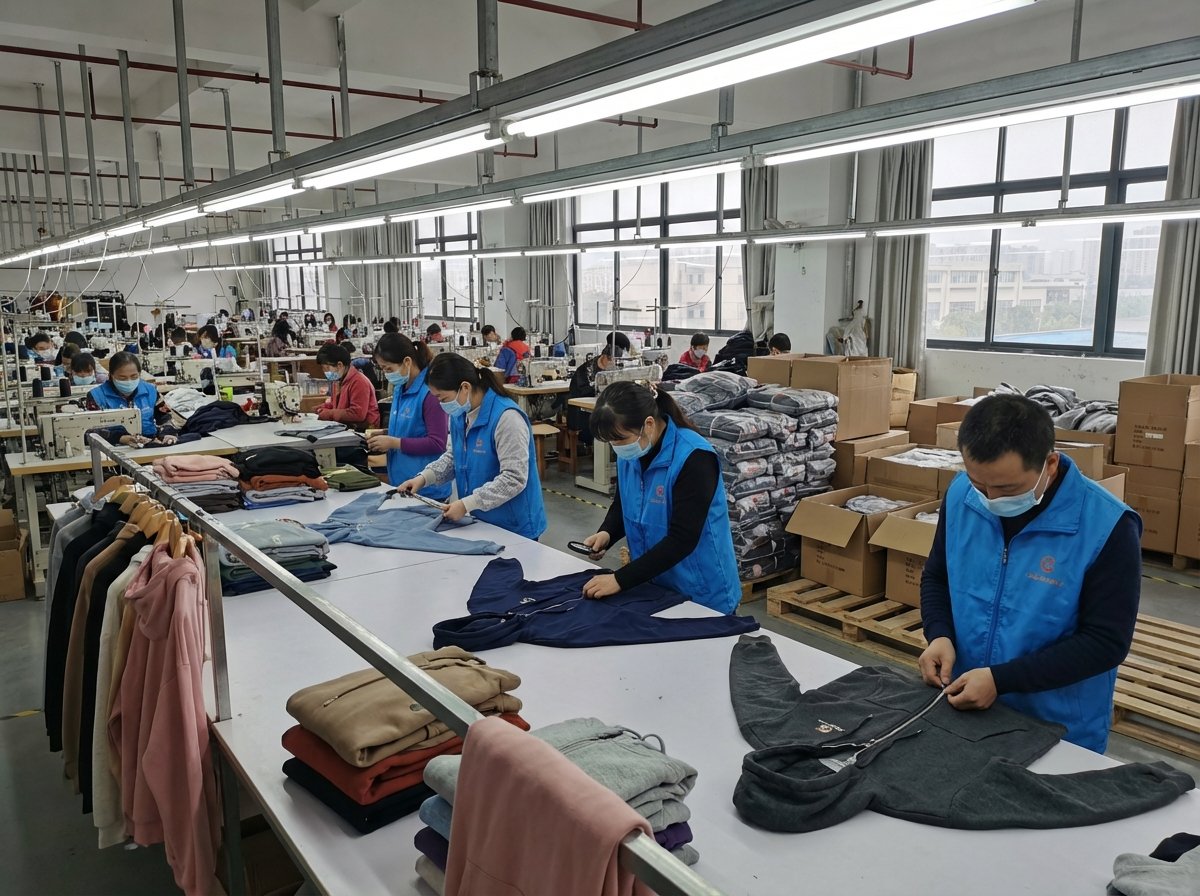
Choosing a hoodie manufacturer is no longer only about price or sample appearance. Market feedback across Reddit, Amazon, Trustpilot, YouTube, Instagram, and review sites shows the same pattern again and again. Buyers complain about hoodies that shrink after one wash, feel rough after drying, pill too fast, fade early, fit too small, run too short in the body, or arrive looking nothing like the product photos. These are not random problems. These are factory-side problems. That is why hoodie sourcing in 2025 needs a more careful checklist.
Why Does Choosing the Right Hoodie Manufacturer Matter So Much?
A hoodie factory affects far more than production speed. It affects how the product performs after the first wear, after the first wash, and after weeks of daily use.
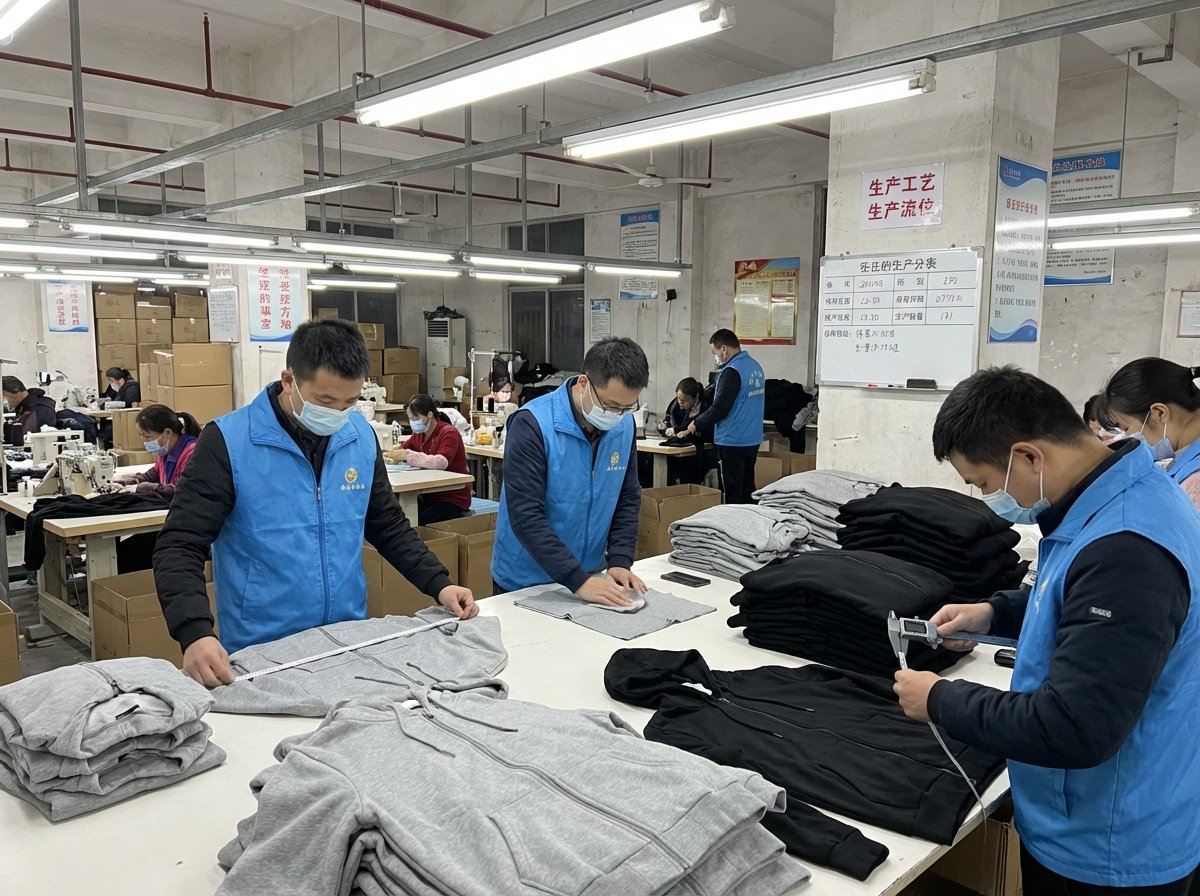
The right hoodie manufacturer protects product reputation by controlling the issues buyers complain about most: shrinkage, pilling, rough hand feel, weak seams, bad sizing, thin fabric, poor hood shape, and quality inconsistency between batches.
Online review patterns make this very clear. Negative comments from many channels repeat the same failures. One group of complaints focuses on shrinkage. Buyers say the hoodie became almost one full size smaller after washing or drying. Another large group focuses on pilling, especially on sleeves, back panels, and other high-friction areas. Softness loss is also common. Many users expect a hoodie to stay soft after washing, but instead describe it as itchy, stiff, rough, or old-looking. Sizing issues are another major problem. Reviews mention short sleeves, short body length, tight arms, narrow elbows, or sizing that is at least one or two sizes smaller than expected.
These failures directly hurt reorder rates. A hoodie may look fine in a photo, but long-term satisfaction depends on fabric choice, pattern balance, pre-shrinking, rib quality, fleece control, sewing standards, and wash testing. A reliable manufacturer understands that a hoodie is not only a cut-and-sew item. It is a comfort product, a repeat-wear product, and often a brand-building product. That is why factory selection matters so much in 2025.
| What buyers expect | What bad factories often deliver |
|---|---|
| Soft and comfortable feel | Rough or itchy feel after washing |
| Stable sizing | Shrinkage and size inconsistency |
| Thick enough for the season | Thin fabric that feels cheap |
| Durable stitching | Seam failure and cuff cracking |
| Long-term shape retention | Loose rib, sagging pocket, twisted fit |
How Should a Hoodie Manufacturer Be Evaluated for Fabric Quality?
Fabric quality should never be judged by sample appearance alone. A hoodie can feel soft on day one and still fail badly after washing.
A strong hoodie manufacturer should prove fabric performance through shrinkage tests, pilling tests, colorfastness tests, softness retention checks, and fabric weight control before bulk production starts.
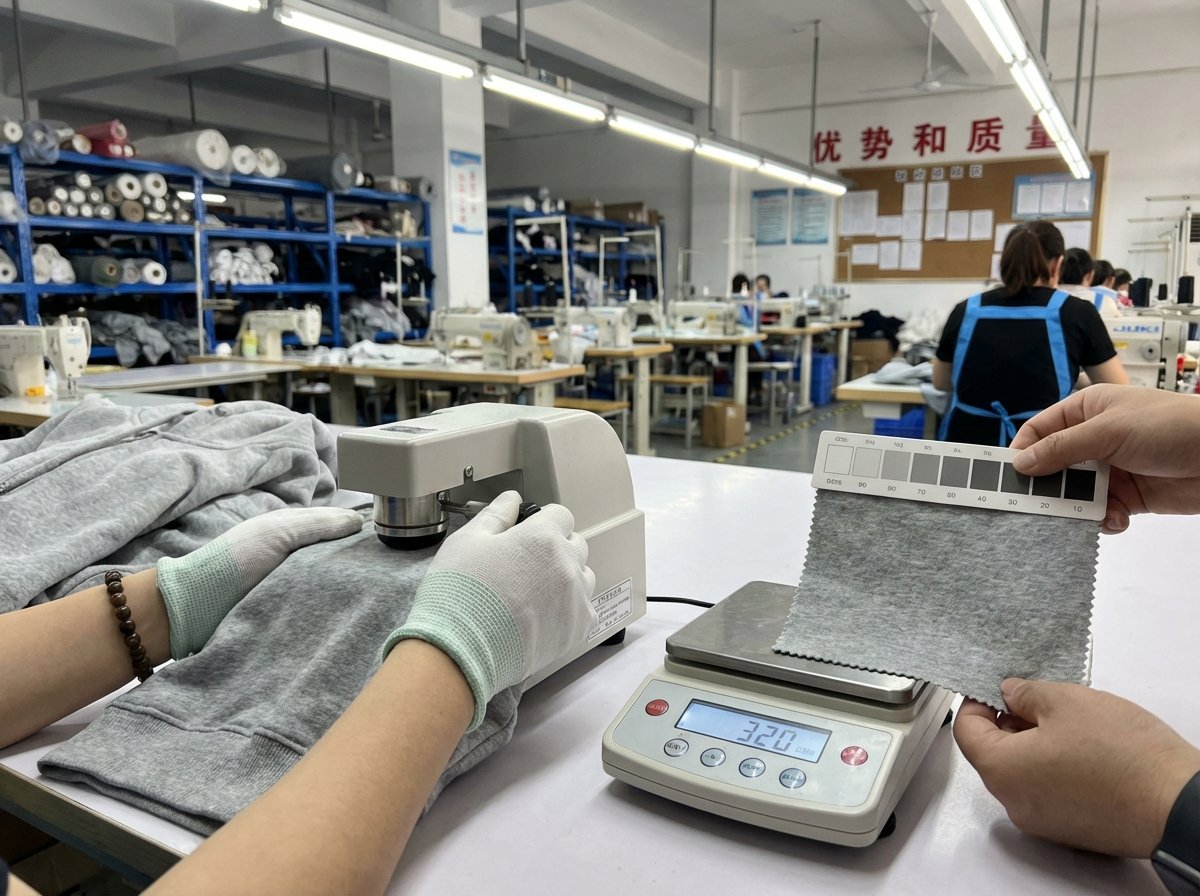
The insight table shows that buyers often describe low-quality hoodies in very direct ways: “paper thin,” “cheap polyester,” “very thin,” “see-through,” “not soft,” or “feels like an old towel.” These comments point to the same root problem. The base fabric does not match product promise. In many cases, the hoodie is too thin for cold weather. In other cases, the fabric blend feels harsh or plastic-like against the skin. Some buyers also complain that the product page suggests heavyweight cotton, while the actual garment feels like a low-cost synthetic top with a hood.
This means factory evaluation must include more than composition labels. A good manufacturer should explain GSM range, fiber blend logic, brushing method, fleece density, surface finishing, and expected wash behavior. Cotton-rich fleece, polyester-cotton blends, and stretch blends can all work well, but each one needs to be honest, stable, and suitable for the target market. Fabric should also be matched to season and product promise. A lightweight layering hoodie should be sold as lightweight. A winter hoodie should feel clearly warmer and fuller.
| Fabric issue from reviews | What it usually means | What a strong factory should do |
|---|---|---|
| Too thin | Low GSM or wrong product positioning | Separate lightweight, midweight, and heavyweight programs |
| Feels cheap or plastic-like | Poor fiber choice or weak finishing | Improve blend, surface touch, and brushing quality |
| Loses softness after wash | Weak fleece structure or poor finishing | Test softness retention after multiple washes |
| Pills too fast | Weak yarn quality or weak surface strength | Upgrade yarn and run anti-pilling tests |
What Quality Problems Show a Factory Is Not Ready for Private Label and OEM Work?
A manufacturer is not ready for branded hoodie projects if quality control only checks appearance before packing.
The biggest warning signs are repeated problems with shrinkage, pilling, fading, seam failure, loose cuffs, poor hood shape, fiber shedding, broken zippers, and incorrect sizing.
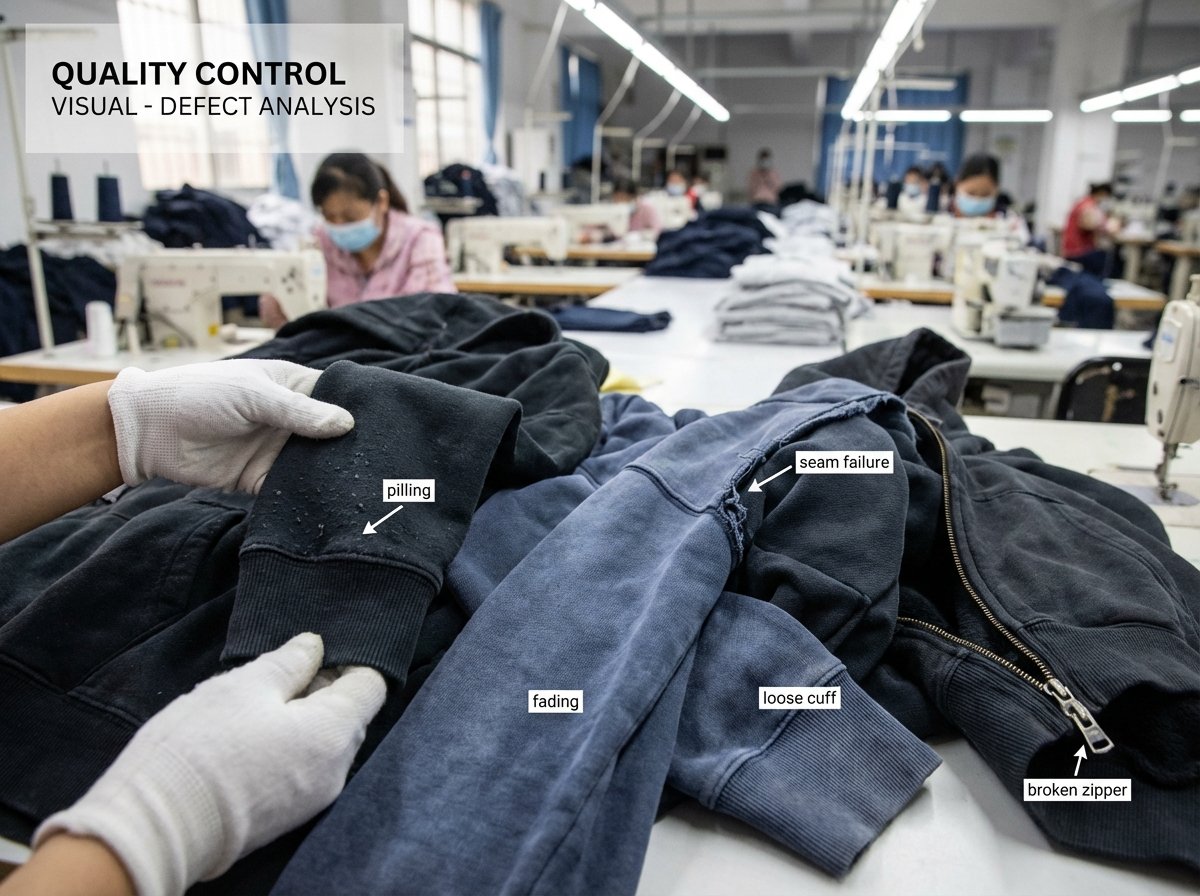
The market feedback in the insight table is highly consistent. Shrinkage appears across Reddit, Amazon UK, Amazon France, Amazon Germany, and YouTube. Pilling appears almost everywhere. Buyers also complain about cuffs stretching out, inner fleece shedding everywhere, body length being too short, sleeves being too short, and seams splitting at cuffs or stress points. Some complaints appear after one wash. Some appear after the first wear. That is a serious sign of weak process control.
These problems usually come from a mix of technical failures. Shrinkage often points to poor pre-shrinking or weak wash testing. Pilling points to low yarn strength or poor surface finishing. Loose cuffs often point to unstable rib quality. Broken seams suggest low stitch density, weak reinforcement, or poor sewing control. Fading points to weak dye fixation. Shedding points to over-brushing and poor lint removal. None of these are small details. They shape customer trust.
A capable manufacturer should treat these as standard control points, not afterthoughts. That means wash testing before order approval, stitch reinforcement in stress areas, cuff recovery testing, zipper durability checks, and measurement tolerance control during bulk packing.
Which Buyer Questions Matter Most Before Choosing a Hoodie Factory?
Good sourcing decisions start with the right questions. Without them, many hoodie problems stay hidden until production is already underway.
Buyers should ask about shrinkage standards, pilling grades, wash testing, fit blocks, GSM tolerance, rib recovery, zipper quality, colorfastness, bulk inspection rules, and how the factory handles repeat orders.
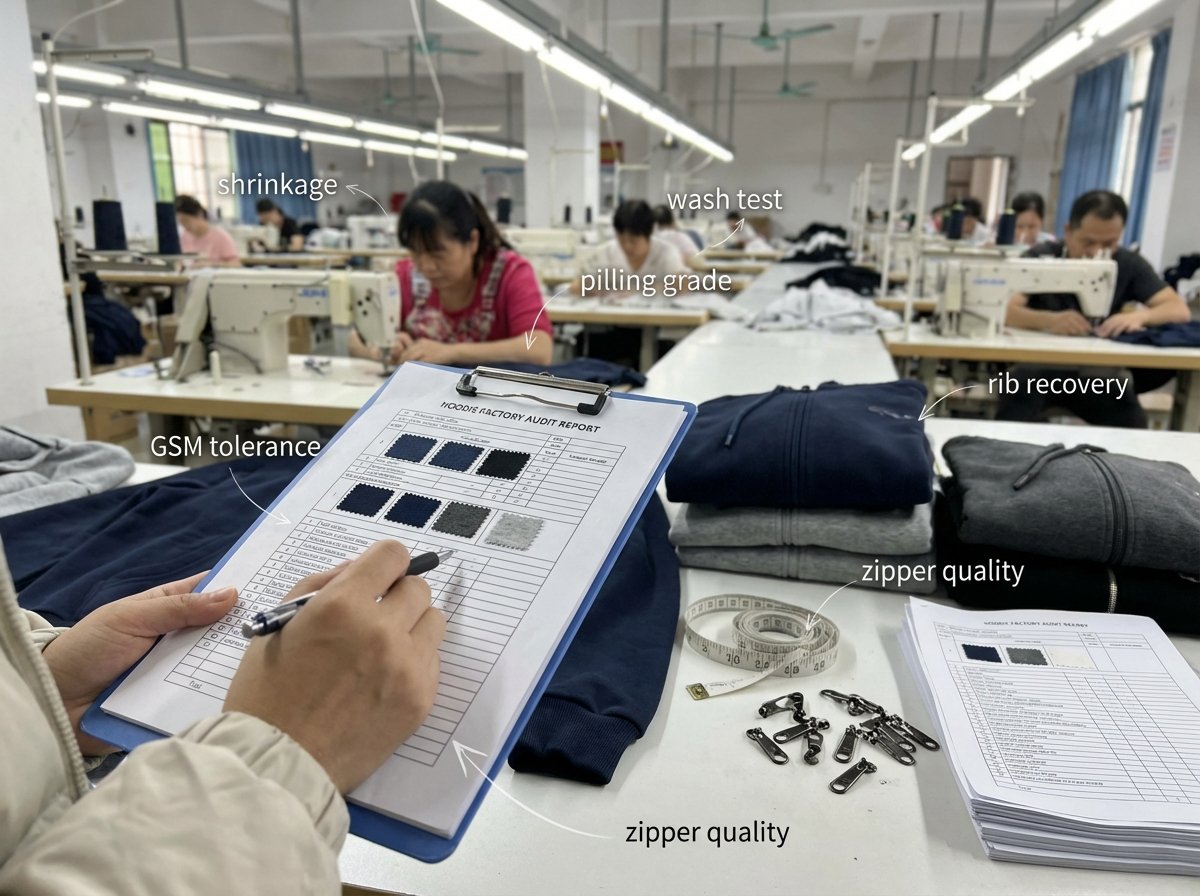
The best buyer questions are direct and measurable. Instead of asking whether quality is good, ask what the allowed shrinkage rate is after washing. Instead of asking whether sizing is accurate, ask how garment measurements are checked during bulk production and what the tolerance is for chest, body length, sleeve length, and cuff opening. Instead of asking whether fabric is soft, ask how softness is maintained after three or five wash cycles.
Questions should also cover product positioning. Is the hoodie meant for winter warmth, daily midweight use, or lightweight layering? Is the hood designed with enough depth and width? Is the pocket reinforced? Is the inner fleece cleaned after brushing? Are dark colors tested for fading and crocking? Are there separate fit blocks for regular, relaxed, and oversized shapes?
These questions help expose whether the factory truly understands hoodie development or only offers generic sweatshirt production.
| Key question | Why it matters |
|---|---|
| What is the wash shrinkage target? | Prevents size loss after first wash |
| What anti-pilling standard is used? | Reduces early surface damage |
| How is size tolerance controlled? | Prevents mixed sizing in bulk |
| What rib recovery test is used? | Prevents loose cuff complaints |
| How are seams reinforced? | Reduces ripping at stress points |
| How is hood shape developed? | Improves comfort and appearance |
How Can Fit, Sizing, and Shape Be Checked More Carefully?
Fit problems are among the fastest ways to lose trust, even when fabric quality is acceptable.
A strong hoodie manufacturer should offer clear measurement charts, stable grading, tested fit blocks, and enough pattern control to avoid short bodies, short sleeves, tight arms, and poor hood balance.
Many negative reviews do not simply say “wrong size.” They describe very specific fit failures. The body is fine but the sleeves are short. The chest feels wide but the arms are narrow. The hoodie is too long like a dress. The neck hole is too small. The hood is too small to wear up. These comments show that hoodie fit is not only about one number. It is about proportion.
A good hoodie factory should have a clear fit strategy. Regular fit should not feel the same as relaxed fit. Oversized fit should not be made by only increasing chest width. Sleeve length, armhole shape, shoulder line, body length, hood opening, cuff width, and hem tension all need balance. Fit should also reflect target markets. European size expectations, North American fit expectations, and oversized streetwear trends do not always follow the same pattern.
Fit review should include static fitting and movement fitting. A hoodie should still feel comfortable when arms bend, shoulders lift, and the hood is worn up. This is especially important for sportswear-inspired or daily casual styles.
What Are the Most Common Red Flags When Sourcing a Hoodie Manufacturing Partner?
Red flags usually appear before the bulk order starts, but they are often ignored because the sample looks acceptable.
The biggest sourcing red flags are vague fabric descriptions, no real test data, unstable sizing, unrealistic prices, over-edited product photos, weak communication, and no clear plan for handling quality claims or reorder consistency.
The insight table highlights several warning signs that keep repeating across review platforms. One major red flag is mismatch between the product image and the actual garment. Buyers complain that the delivered hoodie looks thinner, cheaper, or different in color and pattern. Another red flag is unclear material communication. Some products are presented as cotton-rich or heavyweight, but customer feedback describes thin synthetic fabric instead. Another serious warning sign is a factory that cannot explain testing. If there is no clear answer on pilling performance, shrinkage control, wash behavior, or colorfastness, there is likely no real system behind the sample.
Pricing can also be misleading. A very low offer may mean thin fabric, weak zippers, unstable rib, rushed sewing, or weak finishing. On the other side, high price alone does not prove quality. Reviews show many expensive hoodies still fail at seams, cuffs, or wash performance. The key is not only the quote. The key is the proof behind the quote.
How Should a Final Manufacturer Decision Be Made?
The final choice should be based on evidence, not promises.
The best hoodie manufacturer is the one that can show stable fabric performance, accurate sizing, clean workmanship, strong wash results, honest material positioning, and reliable bulk consistency across repeat orders.
A final decision should compare several points together. Fabric hand feel matters, but it should be judged before and after washing. Sizing matters, but it should be checked across sample measurement, fit balance, and grading logic. Construction matters, but attention should go to cuffs, pocket corners, shoulder seams, hood attachment, zipper areas, and other stress points. Communication matters too, because unclear answers during development often become bigger problems during production.
A hoodie is one of the easiest garments for customers to judge quickly. Comfort, warmth, softness, fit, and durability are all felt almost at once. That is why sourcing mistakes show up fast in reviews. A manufacturer that can control the details behind those experiences will always stand above one that only offers a good-looking sample and a low price.
Conclusion
In 2025, the best hoodie manufacturer is defined by wash performance, fabric honesty, fit stability, durable construction, and bulk consistency. Factories that control these details create stronger products, fewer complaints, and longer product life.