
Choosing T-shirt fabric looks simple at first, but the wrong fabric leads to thin handfeel, shrinkage, pilling, bad print results, and poor long-term wear.
The best T-shirt fabric depends on the end use. Cotton offers softness and familiarity, blends improve stability and function, and slub or combed cotton create different texture, print, and comfort results. Fabric choice affects print clarity, shrinkage, opacity, durability, and how the shirt feels after repeated washing.
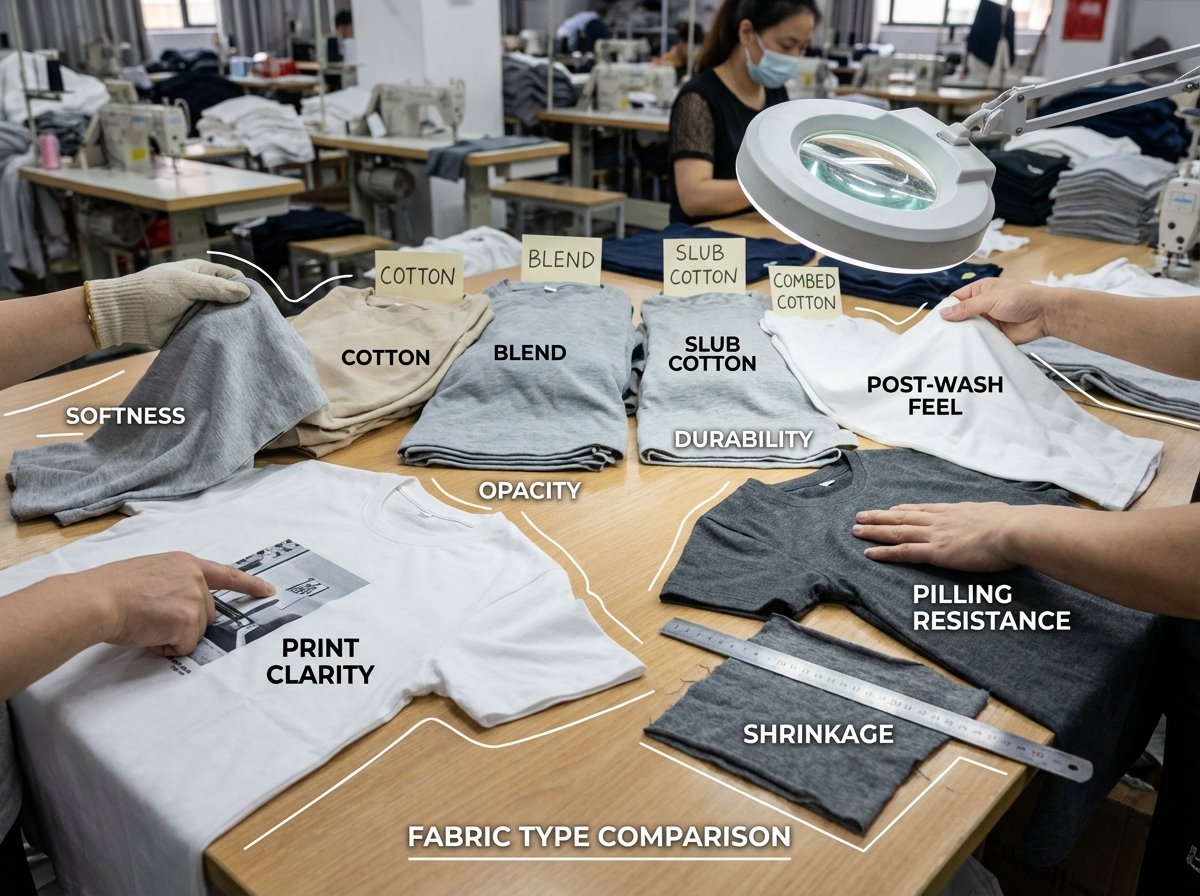
Fabric is the base of every T-shirt. When fabric is right, the shirt feels better, prints better, keeps its shape longer, and creates stronger customer satisfaction. When fabric is wrong, the same complaints appear again and again across the market: white shirts turn see-through, cotton shirts shrink in length, lightweight knits twist after washing, rough yarns pill too quickly, and prints crack because the base fabric and print method were never matched properly. That is why fabric selection should never be treated as a small early step. It shapes the full product from fit and comfort to return rate and repeat purchase.
Why Does T-Shirt Fabric Choice Matter So Much?
Many T-shirt quality problems begin long before cutting, sewing, or printing. They begin with the fabric itself.
T-shirt fabric choice matters because it directly affects softness, opacity, shrinkage, print performance, color retention, pilling, structure, and durability. A shirt can only perform as well as the fabric allows.
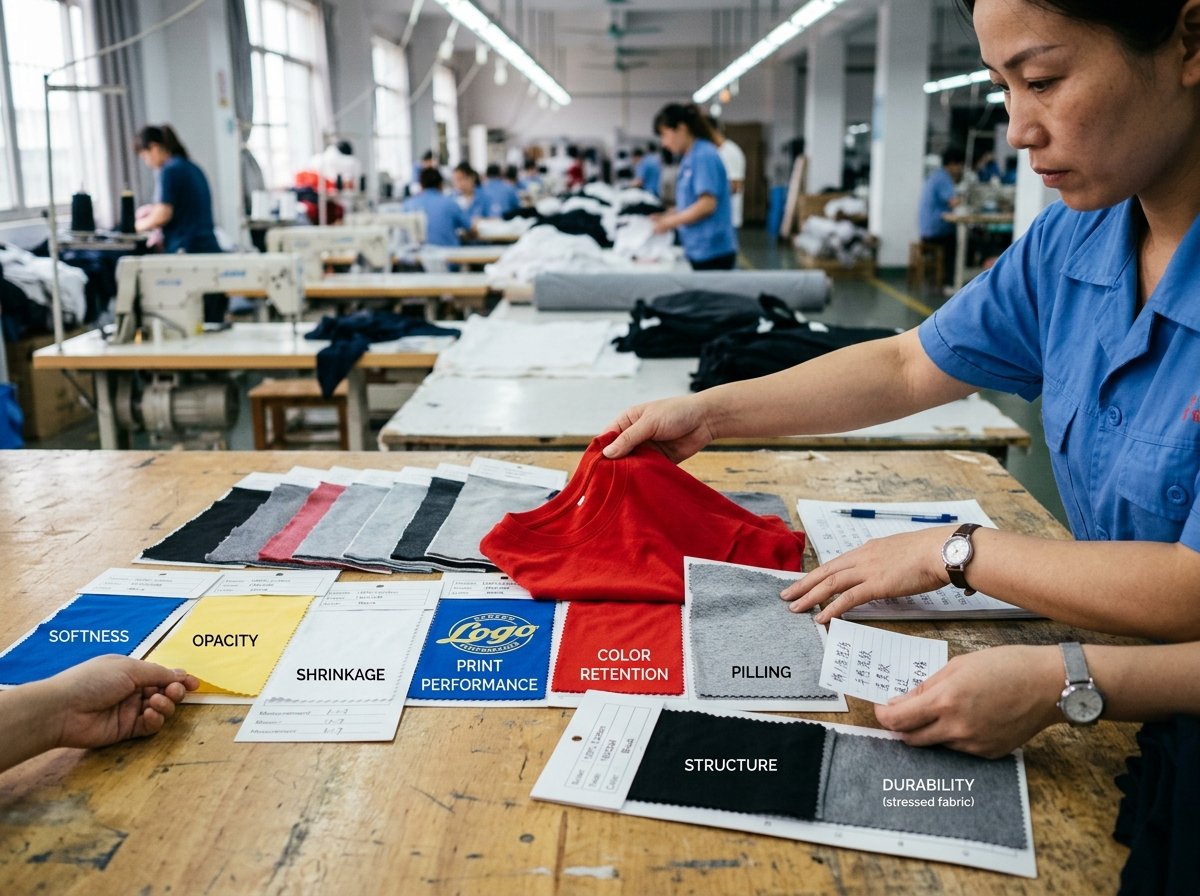
Public feedback around T-shirts is very consistent. Buyers often complain that shirts are too thin, too transparent, too rough, too easy to shrink, or too quick to lose shape. These are fabric-led issues in many cases. White and light colors often fail when fabric weight or knit density is too low. Cotton-rich shirts often fail when shrinkage control is weak. Lower-grade yarns can create rough handfeel and pilling. Stretch-heavy fabrics can lose shape if recovery is poor. Even the best sewing cannot fully rescue the wrong base cloth.
That is why fabric should be selected based on the real use case, not only on cost or trend.
| Fabric Decision Area | What It Changes |
|---|---|
| Fiber content | Softness, breathability, function, shrinkage behavior |
| Yarn quality | Surface smoothness, pilling resistance, comfort |
| Fabric weight | Structure, opacity, drape, durability |
| Knit construction | Stretch, recovery, print surface, shape retention |
| Surface texture | Visual character, print clarity, handfeel |
A good T-shirt fabric does not only look right on day one. It should still feel right after washing, wearing, and storing.
Cotton vs Blended Fabrics for Different T-Shirt Applications?
Cotton is still the most recognized T-shirt fabric, but blends often solve practical problems that pure cotton does not solve as well.
Cotton T-shirts are often preferred for softness, natural handfeel, and classic everyday wear, while blended fabrics can improve recovery, reduce some forms of shrinkage, increase durability, and support active or fashion-specific use. The right choice depends on the application.
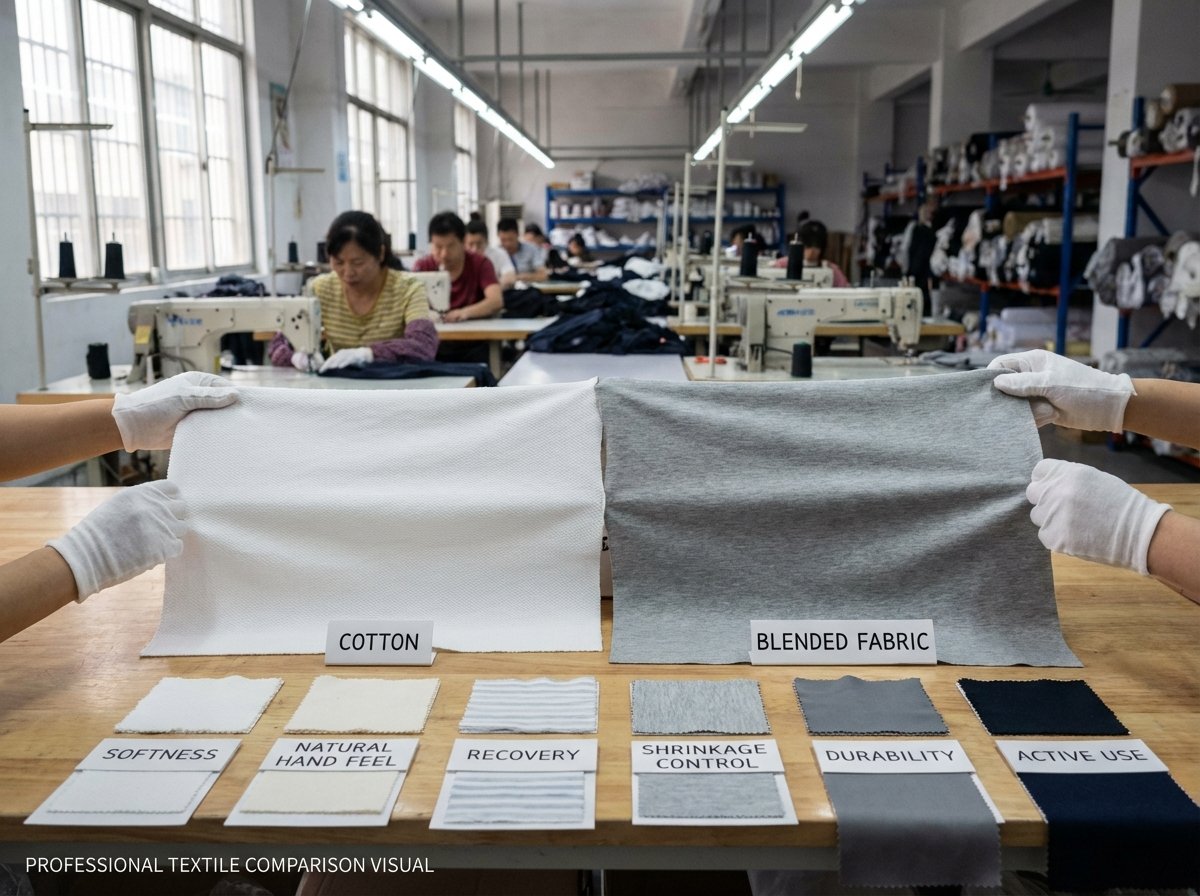
Cotton remains popular because it feels familiar, breathable, and easy to wear. It works well for classic basics, fashion tees, premium everyday programs, and many graphic T-shirts. Strong positive feedback across the market often uses words like soft, comfortable, breathable, durable, and not see-through when cotton fabric is handled well.
Still, cotton also creates some common market complaints when quality control is weak. These include shrinkage, pilling, short body length after wash, and inconsistent texture between batches. This is why many product lines use blends.
Blended fabrics may combine cotton with polyester, spandex, rayon, or other fibers. These blends can help improve stretch, recovery, drying speed, wrinkle resistance, and shape stability. They are especially common in activewear, fitted fashion tees, lightweight summer styles, and performance-focused tops.
| Fabric Type | Best Use Cases | Main Strengths | Main Risks |
|---|---|---|---|
| 100% Cotton | Everyday basics, premium basics, graphic tees | Soft handfeel, natural touch, breathable | Can shrink, pill, or twist if poorly controlled |
| Cotton/Poly Blend | Daily wear, promo tees, active casual styles | Better stability, faster drying, lighter feel | Can feel synthetic if poorly balanced |
| Cotton/Spandex Blend | Fitted styles, women’s tees, stretch basics | Better body fit, more comfort in motion | Can lose shape if recovery is weak |
| Poly-Rich Blend | Performance wear, sport tees, travel styles | Quick-dry, lightweight, lower moisture hold | Can feel plasticky or cheap |
| Rayon or Soft-Hand Blend | Fashion tees, drapey silhouettes | Soft drape, smooth touch | May need careful control for durability |
The best fabric choice comes from product purpose. A heavyweight white basic and a soft draped women’s fashion tee should not use the same fabric logic.
What Buyers Should Know About Slub, Combed Cotton, and Other T-Shirt Fabrics?
Not all cotton fabrics are the same. Terms like slub, combed cotton, ringspun cotton, and jersey all shape the final result.
Buyers should understand that slub cotton adds texture and visual character, combed cotton gives a cleaner and smoother feel, and higher-quality yarn preparation usually improves softness, print clarity, and wear performance. Fabric names describe both appearance and function.
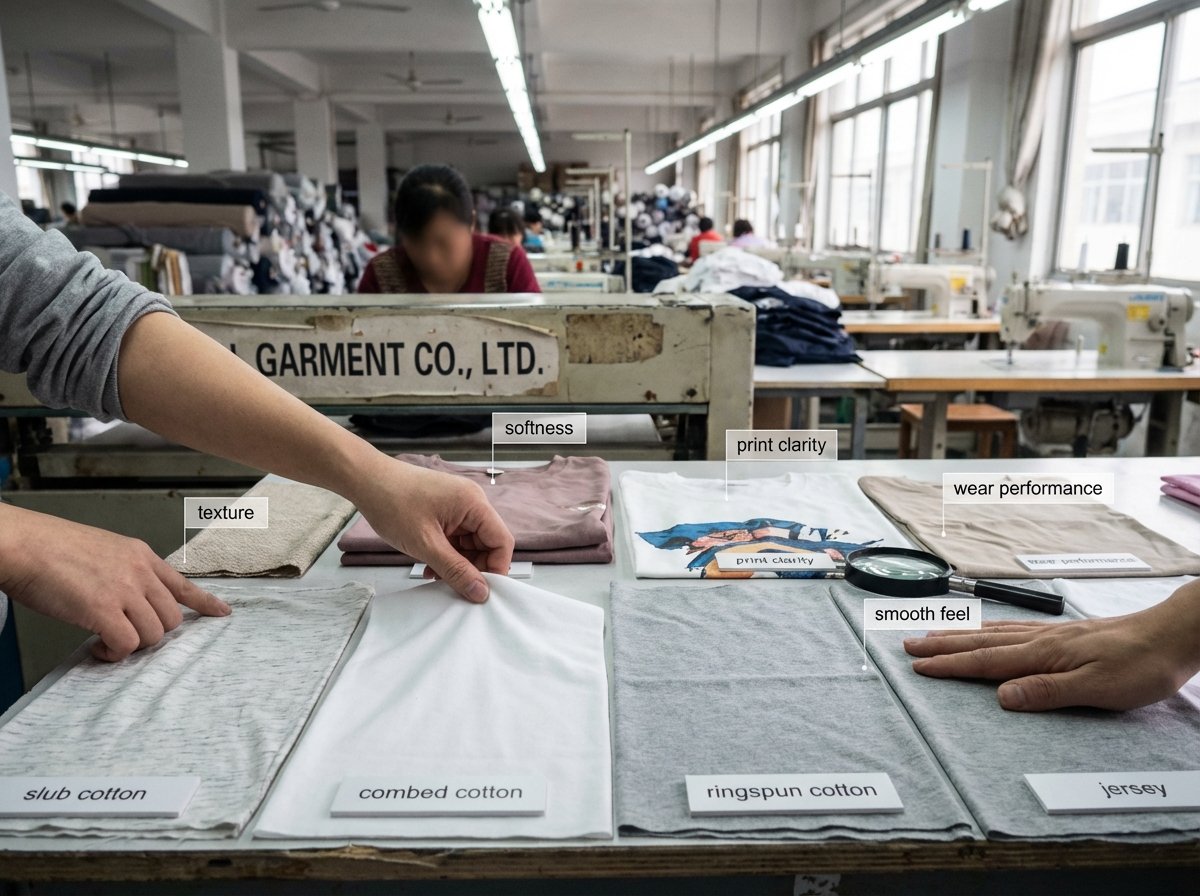
Slub cotton is known for its uneven, textured yarn effect. It gives the fabric a more casual and visual surface. This can work well for washed fashion tees, vintage looks, relaxed summer programs, and brands that want a less flat surface. Slub can create nice dimension, but it also changes print behavior. Very detailed graphics may not appear as crisp on a strongly textured surface as they do on smoother fabric.
Combed cotton is processed to remove shorter fibers and create a cleaner yarn. This usually leads to a softer handfeel, smoother face, and better overall refinement. In many product categories, combed cotton is associated with better comfort and stronger perceived quality.
Other common terms also matter:
| Fabric Term | What It Usually Means | What Buyers Should Expect |
|---|---|---|
| Combed Cotton | Cotton cleaned of shorter fibers | Smoother, softer, cleaner surface |
| Ringspun Cotton | Yarn spun for finer and softer feel | Better handfeel and more refined fabric |
| Slub Cotton | Intentionally uneven yarn texture | Casual visual texture, less flat appearance |
| Carded Cotton | Less refined cotton processing | Lower cost, rougher touch possible |
| Jersey Knit | Standard T-shirt knit structure | Soft stretch, familiar T-shirt feel |
| Interlock Knit | Denser double-knit structure | Smoother, more stable, often less see-through |
For many brands, fabric naming also shapes product positioning. Combed cotton and ringspun cotton often fit premium basics better. Slub fits casual texture stories better. Interlock may fit structured basics better.
How Fabric Type Affects Print Results, Shrinkage, and Wear Performance?
Fabric choice does not stay in the fabric department. It shows up in printing, washing, customer reviews, and long-term product life.
Fabric type affects print results by changing surface smoothness, absorption, stretch, and texture. It affects shrinkage through fiber behavior and finishing. It affects wear performance through pilling resistance, shape retention, durability, and opacity.
Smooth, stable fabrics usually give cleaner print edges and more even graphic appearance. Textured or slub surfaces can create a more broken print look, which may be attractive for vintage styles but less ideal for sharp detail. Stretch fabrics also need print methods that can move with the base cloth. When this match is wrong, cracking often appears early.
Shrinkage is another major factor. Cotton-rich fabrics are often praised for comfort, but they need stronger finishing and pre-shrinking control. Market complaints repeatedly show that many shirts lose body length after washing. This is especially damaging in fitted or tall styles.
Wear performance includes more than whether the fabric tears. It also includes whether the fabric pills, stretches out, loses shape, becomes transparent, or feels old too quickly.
| Fabric Characteristic | Print Impact | Shrinkage Impact | Wear Impact |
|---|---|---|---|
| Smooth combed surface | Better print clarity | Neutral | Better premium feel |
| Textured slub surface | Less crisp detail possible | Neutral | More casual visual character |
| Cotton-rich content | Good print feel in many methods | Higher shrink risk if uncontrolled | Comfortable but must be finished well |
| Stretch content | Needs flexible print choice | Often more stable in body fit | Better motion comfort, depends on recovery |
| Low-density lightweight knit | Can print, but support is weaker | Can distort more easily | More transparency and faster wear risk |
| Dense stable knit | Better print support | More stable if finished well | Better opacity and structure |
A good-looking sample can still fail later if fabric behavior after washing was never checked.
Which Fabrics Work Best for White T-Shirts and Light Colors?
White and light colors create some of the strongest complaints in the T-shirt market. Most of those complaints are linked to poor fabric selection.
The best fabrics for white T-shirts and light colors are fabrics with enough weight, knit density, and opacity to prevent transparency while still keeping comfort and breathability. Lightweight does not have to mean see-through, but it requires better engineering.
One of the most repeated public complaints about T-shirts is that white fabric is too thin. Buyers often say the shirt feels like paper, needs an inner layer, or even shows inner neck printing through the back. This problem appears across value products, fashion basics, merch shirts, and online custom programs.
That pattern shows a simple truth: white fabric should not always follow the same spec as dark colors. In many product lines, white and light shades need their own opacity control.
| White T-Shirt Fabric Need | Why It Matters |
|---|---|
| Higher opacity | Prevents see-through complaints |
| Better knit density | Supports print and improves value feel |
| Balanced softness | Keeps comfort while avoiding limp structure |
| Controlled shrinkage | Protects fit after wash |
| Clean surface | Helps white stay visually fresh |
Strong white T-shirt programs are often described with the same language in positive feedback: thick, soft, not see-through, comfortable, keeps shape. That is a very clear target.
How Should Fabric Be Chosen for Different T-Shirt Applications?
Different T-shirt uses demand different fabric priorities. There is no single best fabric for every product line.
Fabric should be chosen based on product purpose first. Everyday basics need balance, active styles need function, fashion tees may need drape or texture, and graphic styles need a surface that supports the intended print result.
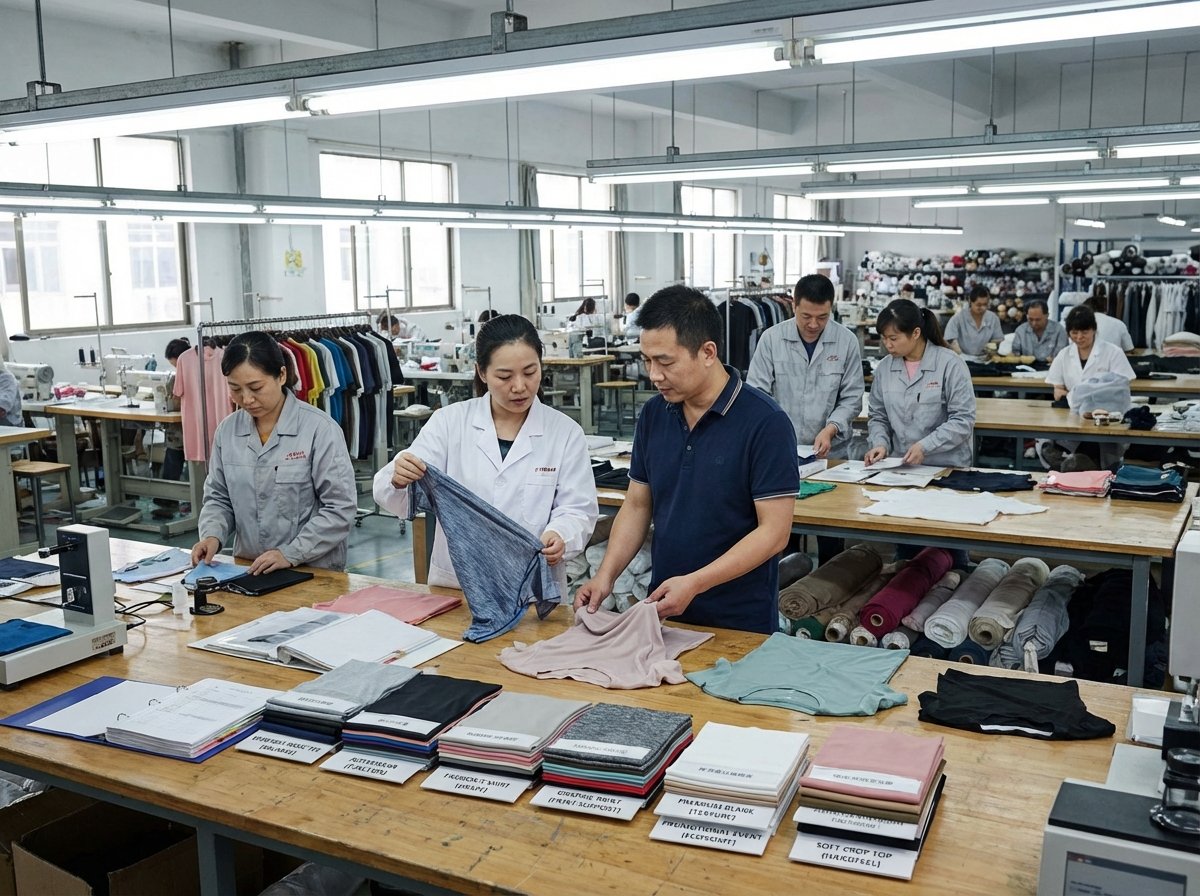
A premium blank tee, a workout tee, a promotional event shirt, and a soft fashion crop top all perform different jobs. That is why fabric selection should start with product role.
| Application | Best Fabric Direction | Key Priority |
|---|---|---|
| Everyday basic tee | Combed cotton or cotton-rich stable jersey | Softness, durability, shape retention |
| White basic tee | Midweight cotton or dense knit cotton blend | Opacity, clean look, stability |
| Graphic tee | Smooth cotton or stable cotton blend | Print support, wash durability |
| Vintage fashion tee | Slub cotton or soft washed jersey | Texture, drape, visual character |
| Active tee | Poly blend or performance knit | Quick dry, lightness, comfort in motion |
| Fitted women’s tee | Cotton/spandex or soft stretch blend | Recovery, body fit, comfort |
| Oversized streetwear tee | Heavier cotton or structured jersey | Drape, body shape, substantial handfeel |
The strongest product lines usually do not chase one fabric for everything. They build fabric choices around the job each shirt must do.
What Fabric Problems Show Up Most Often in the Market?
Understanding market complaints helps buyers avoid repeat mistakes. The same fabric failures show up across many sales channels.
The most common T-shirt fabric problems in the market are transparency, shrinkage, pilling, rough handfeel, color fading, shape loss, and weak durability in high-friction areas. Most of these problems can be reduced through better yarn selection, better finishing, and better quality control.
Across public complaints, several problems appear again and again. Thin fabric creates low value feel and transparency. Poorly finished cotton shrinks in body length. Lower-quality yarns pill after a few wears. Weak surface quality feels rough or dusty. Unstable knits can twist at the side seam after wash. Fabrics with poor recovery lose shape and start to look tired quickly.
| Common Fabric Complaint | Likely Cause |
|---|---|
| Too thin or see-through | Low GSM, weak density, poor opacity control |
| Shrinks too much | Poor pre-shrinking or finishing |
| Pills quickly | Lower fiber quality, hairy yarn, weak finishing |
| Feels rough | Lower yarn refinement or poor softening |
| Loses shape | Weak recovery or unstable knit structure |
| Gets small holes | Weak fabric strength or poor abrasion resistance |
These are not minor details. They strongly shape whether a shirt is seen as cheap, average, or premium.
What Makes a T-Shirt Fabric Feel Premium?
Premium feel is not only about high cost. It usually comes from the balance of softness, structure, stability, and long-term performance.
A premium T-shirt fabric usually feels soft but not weak, smooth but not lifeless, substantial without being stiff, and stable after washing. Strong premium fabrics often combine better yarn quality, cleaner surface finish, stronger opacity, and more controlled shrinkage behavior.
Positive market feedback often uses very direct words: soft, durable, not see-through, keeps shape, washed well, thick but comfortable, true to size after washing. These are simple phrases, but they define premium performance better than many technical claims.
A premium fabric should create a strong first impression and still hold value later. That is why softness alone is not enough. Some very soft fabrics feel great at first but pill quickly or stretch out. Premium fabric should combine comfort and control.
| Premium Fabric Quality | What It Feels Like in Practice |
|---|---|
| Soft handfeel | Comfortable against skin |
| Good opacity | Confident single-layer wear |
| Stable shrinkage | Fit remains trustworthy |
| Clean surface | Better print result and refined look |
| Durable yarn quality | Less pilling and better life span |
| Balanced structure | Keeps shape without feeling stiff |
This balance is what makes buyers describe a T-shirt as worth the price.
Conclusion
The best T-shirt fabric depends on the product goal, but the strongest results usually come from fabrics that balance softness, opacity, stability, print compatibility, and long-term wear performance.