
A jacket’s name is a useful starting point, but it rarely tells the whole story. A bomber can be a lightweight summer layer or an insulated winter piece. A quilted jacket may contain down, synthetic padding, or only a thin layer of batting. A water-repellent shell is not necessarily a waterproof rain jacket.
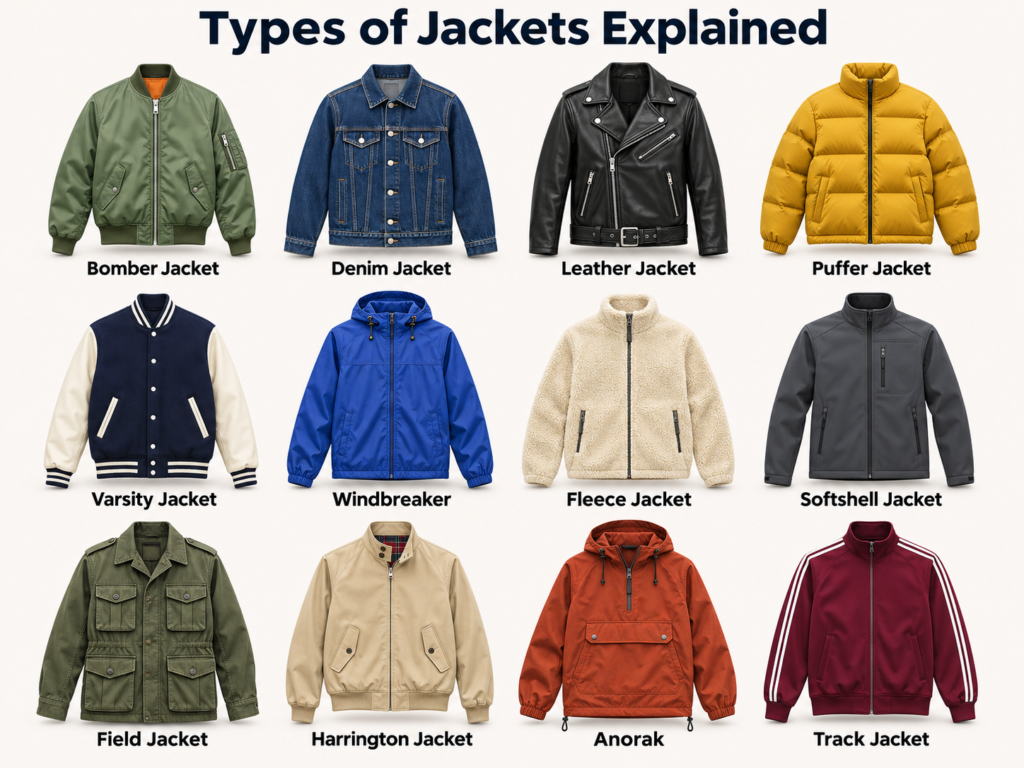
For clothing brands, these distinctions matter when translating a reference image into a production brief. The silhouette determines proportions and detailing; the materials and construction determine how the finished garment behaves.
This guide covers 18 common jacket types, explains how to recognize them, and highlights the development decisions behind each style.
How Jacket Categories Work
Jacket terminology describes several different things:
- Silhouette: bomber, Harrington, field jacket, or blazer.
- Material: denim, leather, corduroy, or fleece.
- Construction: quilted, padded, or shell.
- Purpose: rain protection, wind resistance, or insulation.
These categories overlap. A denim jacket can use a trucker silhouette, while a bomber can be made from leather or quilted nylon.
The styles below are practical product categories, not a strict classification system. Most can be adapted for different fits and customer groups. Longer garments such as parkas also sit across the jacket and coat categories in everyday retail terminology.
1. Bomber Jacket
A bomber usually has a relatively short body, a zip front, and a hem and cuffs that draw the silhouette inward. Ribbing is common, although collar and trim details vary.
The balance between body volume and hem tension is central to the look. Too much tension can make the garment ride up; too little can remove the rounded shape.
Choose shell, lining, and insulation separately. The bomber silhouette alone does not establish a season or warmth level.
2. Varsity Jacket
A varsity or letterman jacket is recognized by its collegiate styling: ribbed trims, a snap front, and often contrasting sleeves. Letter patches, embroidery, and striped ribbing are familiar details.
Traditional-looking versions may combine a wool-blend body with leather sleeves, while lighter interpretations use other fabrics.
For development, test how the body, sleeves, ribbing, and decoration behave together. Different materials may respond differently to cleaning, pressing, and wear. Position patches before finalizing pocket openings and seam placement.
3. Harrington Jacket
The Harrington is a short zip-front jacket with a restrained, sporty appearance. Familiar details include a stand collar, slanted pockets, and ribbed cuffs and hem. Baracuta’s G9 is a well-known reference, with an umbrella back yoke and raglan sleeves.
Compared with a fuller bomber, the Harrington often reads as a cleaner everyday layer.
Review collar closure, shoulder movement, and hem position in the sample. A small change in length can shift the jacket’s proportions substantially.
4. Denim and Trucker Jackets
“Denim jacket” identifies the fabric; “trucker” describes a recognizable design family. Familiar trucker details include a button front, chest flap pockets, shaped seams, and a relatively short body.
Trucker-inspired jackets can also be made from corduroy, canvas, or other materials.
For denim development, approve the intended wash before final fit confirmation. Assess measurements, seam appearance, shade, and hardware after finishing. The unwashed sample is not a complete reference for a washed production garment.
5. Chore Jacket
A chore jacket is a workwear-derived layer with a straightforward shape and prominent patch pockets. Cotton canvas, denim, and twill are useful material candidates. Some versions are lined; others remain light and unstructured.
Its character comes from proportion and utility rather than elaborate shaping.
Check whether pockets are accessible when the wearer sits or carries a bag. Reinforcement, pocket placement, and seam bulk deserve attention even when the jacket is intended primarily as fashion.
6. Field Jacket
A field jacket has a utilitarian appearance, usually with multiple front pockets and enough body length for practical coverage. Stand collars, storm flaps, and adjustable waists appear in many interpretations.
It provides more room for functional detailing than a short bomber, but extra components add assembly work and weight.
Clarify which details need to function. A decorative pocket flap is different from a usable bellows pocket, and a fashion hood requires a different brief from one intended for dependable weather protection.
7. Shirt Jacket or Shacket
A shirt jacket combines shirt-like details with the fabric weight or layering room of outerwear. It commonly has a shirt collar, a button or snap front, and chest pockets.
Materials can range from brushed checks to twill and padded constructions. Some versions behave like heavy overshirts; others are effectively lined jackets.
Define the intended underlayer before setting measurements. Enlarging a shirt pattern without reviewing armholes, sleeves, and collar proportions can produce an awkward fit.
8. Track Jacket
A track jacket is a zip-front layer associated with sportswear and coordinated tracksuits. Stand collars, contrast panels, stripes, and elasticated or ribbed openings are common.
It can use tricot, interlock, stretch woven fabric, or other suitable materials. Its appearance may be athletic even when the intended use is casual.
When developing a matching set, compare jacket and trouser shade, surface finish, stretch, and wash behavior. Check that the zipper remains flat after care.
9. Biker Jacket
The classic biker or double-rider silhouette uses an asymmetric front opening, lapels, and visible hardware. A belt, zipped pockets, and sleeve zips may reinforce the look.
Leather is a familiar material, but textile and coated alternatives also exist. Each creates different drape, seam bulk, and care requirements.
Review the jacket open and closed. Lapels that lie neatly in one position may behave differently in the other. Test pocket access and how the hem feels while sitting.
10. Anorak
An anorak is commonly a hooded pullover outer layer with a partial front opening. Large front pockets and adjustable hems are frequent design features.
It offers a relatively uninterrupted front panel, making pocket layout and opening depth important.
Test dressing and removal over the intended layers. If access requires a side zipper, specify its length and finish early. A hood and synthetic shell do not establish that the garment is waterproof.
11. Fleece Jacket
A fleece jacket uses a raised-surface knit as its main material. Full-zip and half-zip versions are common, and different pile structures create different appearances and levels of bulk.
Fleece can provide an insulating layer, but warmth and wind resistance are separate considerations.
Check pilling, shedding, rubbing at high-contact areas, and pocket stability. Evaluate it under any intended outer shell. A sample that feels comfortable alone may be too bulky in a layered system.
12. Windbreaker
A windbreaker is a lightweight outer layer intended to reduce wind exposure. It often uses woven synthetic fabric, with a hood, adjustable openings, or ventilation depending on the design.
Some versions have a water-repellent finish, but that does not make them equivalent to rain jackets.
For development, review airflow, fit, packability if required, and comfort during movement. Confirm what weather-related claims the finished garment can support.
13. Rain Jacket or Hardshell
A rain jacket is designed around wet-weather protection. Hardshell is a broader performance term often used for protective outer shells; the exact specification still needs confirmation.
Waterproof performance involves more than selecting a coated or laminated fabric. Seams, closures, hood construction, and garment assembly all matter. Gore’s guidance illustrates this distinction through its use of laminates, seam tapes, construction requirements, and finished-garment assessment.
Plan pocket openings, adjusters, branding, and stitching around the waterproof construction. A decorative seam or embroidered logo can introduce an issue that the base fabric alone cannot resolve.
14. Softshell Jacket
Softshell describes a family of outerwear emphasizing a softer feel and movement, with varying degrees of weather protection. Fabrics may be stretch woven, bonded, membrane-based, or fleece-backed.
The term does not specify one fixed level of waterproofness. Some products prioritize air exchange; others incorporate waterproof technology.
Ask for the actual fabric construction, relevant test results, and seam treatment. Then assess mobility and heat comfort in a finished sample. Avoid approving performance from the word “softshell” alone.
15. Puffer Jacket
A puffer has visible loft created by insulation held within channels or compartments. It may contain down, synthetic fill, or another suitable insulation.
For down products, fill power describes the volume occupied by a measured amount of filling under specified test conditions. It is not a complete warmth rating for the jacket.
Specify fill type, amount, distribution, compartment construction, and intended fit. Review insulation consistency, cold spots, leakage, and mobility. The outer appearance alone cannot show whether the garment meets the warmth expected by customers.
16. Quilted Jacket
Quilting joins layers in a stitched pattern, such as diamonds, horizontal lines, or a more decorative layout. Quilted jackets can be lightly padded or heavily insulated.
A puffer can therefore also be quilted. The terms emphasize different aspects: puffers highlight loft, while quilting describes how layers are secured.
During sampling, check pattern alignment, padding distribution, seam intersections, and appearance after care. Stitching density and layout can change both flexibility and visual proportion.
17. Parka
A parka is generally a longer, hooded outer garment with more coverage than a cropped jacket. Insulated winter versions are familiar, but lighter shell interpretations also exist.
The name does not guarantee extreme-cold performance or waterproofness. Those depend on the materials and construction.
Length affects walking, sitting, and access to pockets. Review hem opening, zipper operation, hood adjustment, and the fit over intended layers. A two-way zipper may be useful where the design needs additional movement at the lower front.
18. Blazer and Casual Tailored Jacket
A blazer uses tailored elements such as lapels, a structured front opening, and shaped sleeves. Versions range from soft, unlined casual layers to more structured garments.
Fabric choice, shoulder construction, internal support, and pressing determine much of the result. A technical drawing alone may not communicate the desired level of structure.
Define how formal the jacket should feel and what it will be worn over. Review shoulder balance, lapel behavior, sleeve movement, and button position on the body.
Comparing Jacket Styles by Product Purpose
Use this table to build a shortlist for development rather than treating it as a guarantee of performance.
| Product direction | Styles worth considering | Main development questions |
|---|---|---|
| Everyday casual collection | Bomber, Harrington, trucker, chore | Proportions, layering room, fabric hand |
| Streetwear range | Varsity, bomber, track, oversized shirt jacket | Volume, branding, trim compatibility |
| Workwear-inspired collection | Chore, field, denim jacket | Pocket function, reinforcement, finishing |
| Lightweight outerwear | Windbreaker, anorak, shell track jacket | Mobility, ventilation, closures |
| Rain protection | Rain jacket, suitable hardshell | Fabric performance, seam sealing, hood and closure design |
| Insulated winter range | Puffer, quilted jacket, insulated parka | Fill specification, coverage, construction |
| Smart casual collection | Harrington, blazer, refined shirt jacket | Drape, shoulder fit, internal structure |
Three Distinctions That Prevent Specification Errors
Water-Repellent Does Not Mean Waterproof
A water-repellent finish encourages water to bead on the surface. Waterproof protection requires an appropriate barrier and a garment construction that controls water entry.
Gore describes DWR as a surface treatment used alongside its waterproof membrane, rather than the component that makes the laminate waterproof.
For a development brief, specify the intended exposure and agree on relevant fabric and garment testing. A splash demonstration is not a substitute for an agreed performance assessment.
A Material Name Does Not Establish a Style
Leather can form a bomber, biker, blazer, or shirt jacket. Denim can form a trucker or chore coat. Corduroy can appear across several silhouettes.
Communicate both the material and shape when requesting a quote. “Cotton-canvas chore jacket with four patch pockets” gives a factory a clearer starting point than “work jacket.”
Insulated Does Not Automatically Mean Winter-Ready
An insulated jacket’s performance depends on the complete design: filling, quantity, distribution, shell, coverage, closures, fit, and intended conditions.
Ask for a specification that supports the proposed use. Avoid assigning a temperature rating based only on garment thickness, fill power, or appearance.
What Brands Should Define Before Sampling
Begin with a reference style, then turn the features you want into measurable requirements.
Your brief should include the intended customer and use, fit, garment length, size range, shell, lining, insulation if needed, pocket layout, closures, branding, and care expectations.
Review the sample in the conditions that affect the design:
- Wear it over the intended underlayer.
- Reach forward and overhead.
- Sit with the front closed.
- Open pockets while wearing it.
- Adjust the hood and cuffs where applicable.
- Check that lining and insulation do not restrict movement.
- Review relevant appearance and measurements after care.
Record feedback against the current technical specification. Keep the approved sample as a reference for bulk production, and clarify any remaining substitutions before approval.
Frequently Asked Questions
What is the difference between a jacket and a coat?
Jackets are often shorter, while coats generally provide more length and coverage. Retail terminology overlaps, especially for parkas and workwear. Use actual garment measurements when discussing production.
Are all puffer jackets filled with down?
No. Puffer jackets can use down or synthetic insulation. Confirm the filling specification rather than inferring it from the silhouette.
Can a fashion jacket also be waterproof?
Yes, if its materials, construction, and verified performance support that claim. Fashion details need to be developed around the protective system rather than added without considering their effect.
Which jacket is easiest for a new brand to develop?
That depends on the supplier’s existing patterns, machinery, materials, and experience. An established style with limited modifications may require less work than an original lined or technical garment. Compare the actual development scope before deciding.
Develop Your Jacket Collection With Yoplook
Choosing a jacket style establishes the visual direction. Fit, materials, lining, closures, and finishing turn that direction into a wearable product.
At Yoplook, we support custom clothing development through fabric sourcing, pattern work, sampling, production, and branded finishing. Share your jacket references, material preferences, size range, estimated quantities, and target market to discuss the scope and requirements of your collection.